Checked luggage packing goes wrong for three reasons, and only one of them is about how you fold a shirt. The other two are the shape of the bag and where the weight sits inside it. Get those wrong and you are the person at the counter pulling a jacket out of a bulging bag while a line forms behind you.
I spent six years working the gate at O'Hare before I started reviewing luggage full time, which means I have watched thousands of bags get stacked, thrown, and dropped onto a belt at two in the morning. I fly more than 120 segments a year now and keep 11 bags in active rotation. I judge every one of them the way I did from behind the counter: what survives the belt, what fits the bin, and what the airline will not fight you about.
This guide covers the two shapes that handle almost every trip, a 22-inch wheeled duffel and a 25-inch checked spinner, and walks through how to pack each one so it arrives with the zipper intact.
Why you should trust me
Six years as a gate agent at O'Hare, four years of flying more than 120 segments a year, and 11 bags in active rotation. Most of what I know about luggage I learned the wrong way, by watching a bag come down the belt with a wheel missing or a handle bent back toward the shell.
I do not care how a bag photographs. I care whether the zipper survives 20 flights, whether the handle wobbles before the first one, and whether the empty weight of the case is quietly eating the allowance you paid for.
How I judge a bag before it gets packed
Four things matter more than anything on the marketing page.
Linear inches. Length plus width plus height, including wheels and handles. That is the number the airline measures, and it is usually an inch or two bigger than the number on the tag. Measure your own bag with a tape before you trust a spec sheet.
Empty weight. A heavy case eats your allowance before you pack a single shirt. Weigh the empty bag on a bathroom scale, then weigh it again packed.
Wheelbase. A four-wheel spinner on a narrow base tips in a jet bridge turn. A two-wheel duffel leaning on a wide axle drags straight behind you, which is why crews still use them.
Handle wobble. Extend the handle and shake it side to side. If it rattles before the first flight, it will rattle worse after twenty.
One caveat, and it is the one people get burned by: airline size and weight rules change, and they change without much warning. Check your carrier's current published limits before you fly, not the number you remember from last spring.
The two bags that cover most trips
You can spend a lot of money on luggage and still end up with the wrong bag for the trip. These two cover the practical middle of the market: a soft rolling duffel for gear-heavy travel and a four-wheel spinner for a week of clothes.
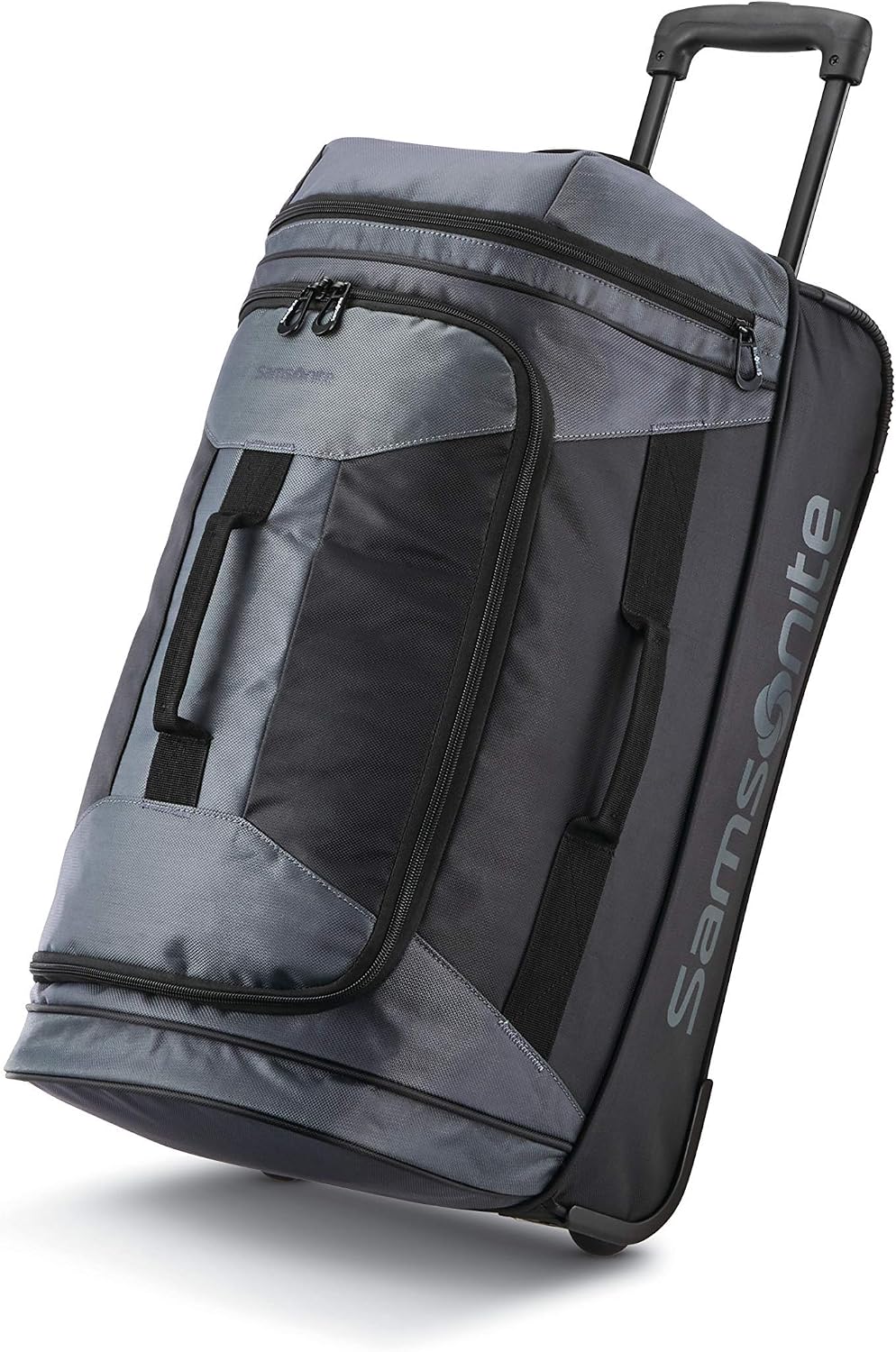
Budget pick: Samsonite Andante 2 Wheeled Duffel Bag, 22-Inch Durable Rolling Luggage with Inline Skate Wheels, Push-Button Handle & Spacious Compartments, Travel-Friendly and Lightweight - Moss Green/Black
 Visit on Amazon →
This is the shape I would hand to anyone whose packing list includes boots, a helmet, camera gear, or a jacket that refuses to fold flat. It is a 22-inch rolling duffel with inline skate wheels and a push-button handle, and the soft body is the whole point. Nothing on it cracks at the corner when the belt drops it wrong, because there is no hard corner to crack.
The wide duffel opening is what separates it from a spinner. You load it like a gym bag, not like a puzzle. The inline skate wheels track straight on tile and carpet, and the push-button handle locks at height so you are not stooping through a terminal.
A note on how it rolls: two wheels mean you tip the bag toward you and drag it, which is stable and fast on a straight concourse but less nimble in a tight aisle. That is the tradeoff for the axle position, and it is one I would take on a road trip or a regional flight.
Flaws but not dealbreakers: Soft sides absorb impact but they pass it along to your contents, so wrap anything fragile in the middle of the load. The duffel body also compresses less than a hard shell when you cinch it down, so pack it once, properly.
Anyone hauling bulky or awkward gear who wants a bag that bends instead of breaking should start here.
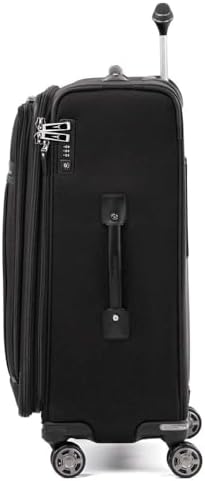
Upgrade pick: Travelpro Platinum Elite Checked Luggage Spinner, Grey, 25-Inch
 Visit on Amazon →
This is the checked bag for a week of clothes, and it is a four-wheel spinner in the 25-inch class, which is the size that carries a full trip without wandering into oversized territory. Travelpro is the brand the crews carry for a reason, and the Platinum Elite line is the step above the value line.
The four-wheel chassis is the reason to pick it over the duffel when your load is mostly soft goods. You roll it upright beside you with a hand on the top handle, the weight stays off your wrist, and you are not dragging anything behind your heels in a crowded concourse. The grey finish hides belt scuffs better than the light colors do, which sounds like a small thing until you have claimed a bag after a winter trip.
Flaws but not dealbreakers: A bigger bag invites overpacking, and an overpacked spinner is a heavy bag standing on four small wheels that were never meant to take a curb drop. Keep it under the limit and it behaves. Also remember that anything checked can be delayed, so medication and one day of clothes belong in the bag that stays with you.
Anyone flying a week at a time with mostly clothes, and checking a bag on purpose rather than by surrender, will get the most out of this one.
The packing workflow
This works for either bag. The order matters more than the technique.
Step one: Weigh the empty bag. Stand on a bathroom scale, then stand on it holding the bag, and subtract. Write the number down. That is how much of your allowance is already spent before you pack anything.
Step two: Measure it yourself. Tape measure, all three dimensions, wheels and handles included. The 22-inch duffel and the 25-inch spinner sit in different categories on most carriers, and the published limits are what the counter measures against. Verify your airline's current rules rather than assuming.
Step three: Put the heavy items over the wheels. In the spinner, that means flat against the back panel, closest to the handle and the wheel housing, so the bag stands upright on its own and does not tip when you let go. In the duffel, that means at the end nearest the axle, so the weight stays low and the drag stays light.
Step four: Build in layers, not in piles. Soft items against the walls, a flat layer of folded clothes in the middle, heavy items at the bottom near the wheels, and the things you will want at the hotel on top. Packing cubes are the single best travel purchase under $50. They do not save space, they save your sanity at 3am in a hotel room when you are looking for a charger.
Step five: Use the duffel's mouth. Load it like a bag, not like a case. Bulky soft items go around the perimeter, hard items go in the center where there is padding on every side, then cinch the straps to pull the load tight. A loose load shifts, and a shifting load pulls on the zipper every time the bag changes direction.
Step six: Leave the expansion zipper alone. Expansion is a marketing feature that turns a legal bag into an oversized one and puts the zipper under load it was not built for. Keep it zipped. If the bag will not close, you are bringing too much, not carrying too little bag.
Step seven: Weigh it packed, at home. Same scale trick as step one. If you are over, redistribute before you leave the house: wear the heavy shoes on the plane, move the jacket to your personal item, and pull the toiletry bag out of the checked bag. Doing this at the counter is how people end up paying fees with an audience.
Step eight: Close the zipper properly. Lay the bag flat, run the zipper once around empty to check for a snag, pull the liner out of the teeth, then close it. Zippers are the first thing to die on any bag. Do not help yours along.
Step nine: Lock it, tag it, photograph it. TSA-approved lock on the main compartment, a tag with your name and a phone number on the outside and a second one inside, and a photo of the packed contents on your phone. If the bag goes missing, that photo is worth more than the receipt.
The competition and why it lost
A few other shapes come up in every conversation about checked luggage, and they lose for specific reasons.
Hard-shell polycarbonate spinners look tough and photograph beautifully, but the shells crack at the corners when the belt drops them wrong. I have seen it enough times that I stopped being surprised. If you fly a lot and check a bag, a soft body is the more forgiving choice.
Travel backpacks are excellent for one-bag travel and terrible for a week of clothes and shoes. The straps catch on every belt and carousel, and most of them get checked anyway on regional flights.
Garment bags solve a problem almost nobody has. Unless you are carrying a suit to a wedding, the hanging compartment costs you more space than it saves.
And oversized 28 to 30-inch cases are the bags that get checked and then get lost. The best luggage is the size you actually need, not the size you are tempted to buy. A 25-inch spinner holds a week. A 30-inch case holds a week and a half and a lot of regret at the baggage service desk.
Luggage sets deserve their own line. They force you to buy a bag you do not need in order to get the one you do, and the smallest bag in the set is usually the one that never leaves the closet.
What this all costs
The bags are the cheap part of the trip. The expensive part is what you pay when a bag is over the limit, or when you replace a bag that died on the belt halfway through its second year.
Check current Amazon price on both bags and compare the two honestly. The duffel is the value play: soft body, two wheels, a load-it-and-go shape that handles gear. The spinner costs more because there is more hardware on it, four wheels and a chassis that has to hold the bag upright, and that hardware is also the first thing to break if you drag it off curbs.
Then look up your airline's current checked bag fees and its current size and weight limits before you book. If you check two bags a year, the fee math is easy to justify. If you check two bags a month, the case weight matters more than the price tag, because every pound of bag is a pound stolen from your packing.
The short version
Weigh the empty bag, measure it yourself, put the heavy things over the wheels, pack in layers, skip the expansion zipper, and weigh it again at home before you leave. Pick the duffel when your load is bulky and soft. Pick the 25-inch spinner when your load is clothes and you want the bag to roll itself through the terminal.
That is the whole job. A bag is a rental you buy, and the airline will treat it like it is disposable. Pack it like you expect it back.