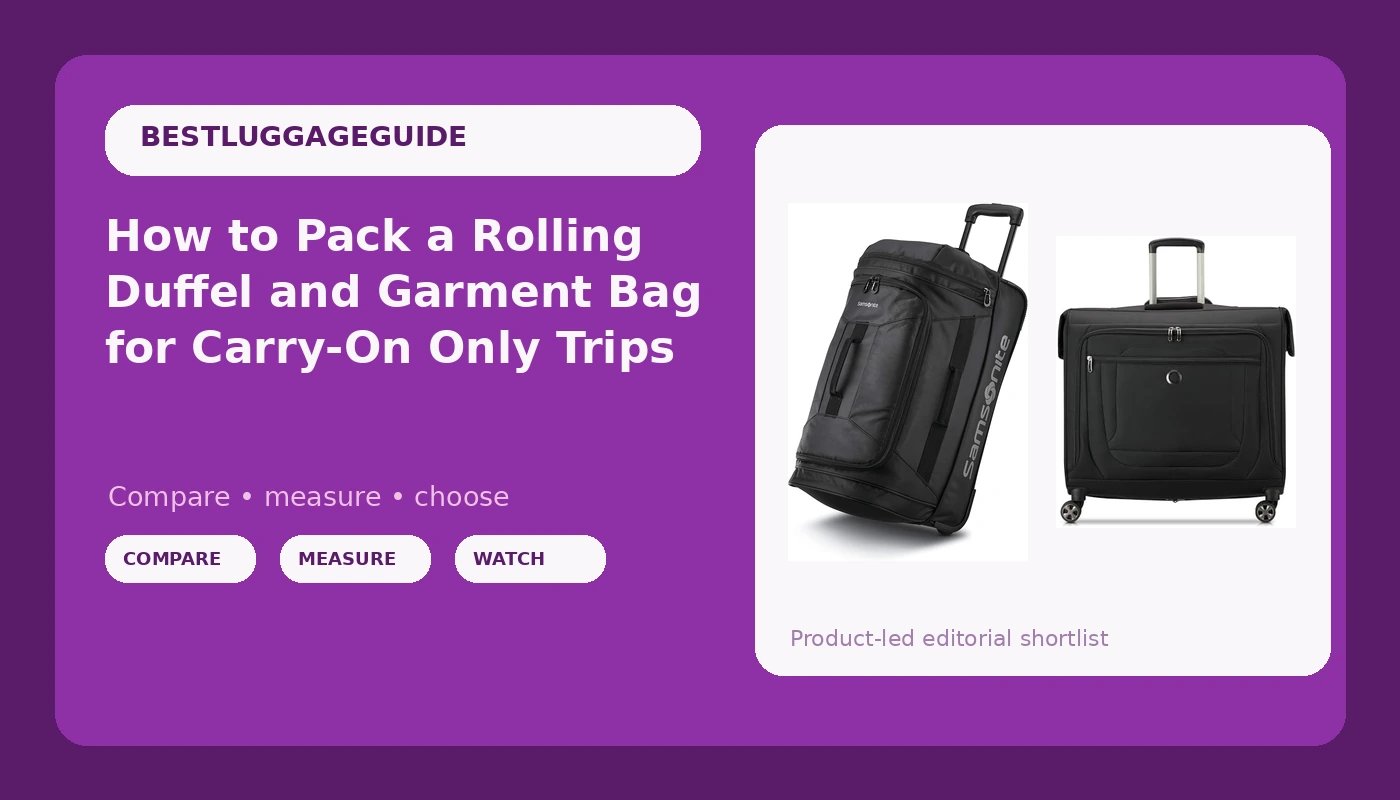
Most travelers pack one bag badly and then blame the bag. I spent six years as a gate agent at O'Hare, and I have watched thousands of bags come down the belt, get stacked three deep in a cart, and get thrown into a bin. The pattern never changes. The traveler who packed a rolling duffel and garment bag with a plan had an easy trip, and the traveler who stuffed one case to the zipper limit was the one repacking on the jet bridge while the agent called final boarding.
A rolling duffel and a garment bag are not competing purchases. They solve two different problems. The duffel is for soft goods and volume, the kind of trip where you want to throw in shoes, a jacket, and a week of clothes and still close the top. The garment bag is for the trip where something has to arrive on a hanger and look like it was never in a bag at all.
This is the workflow I use for both, plus the two bags I would actually start with if you are buying today.
Why you should trust me
I worked the gate at O'Hare for six years before I started reviewing bags full time, and I have flown more than 120 segments a year for the last four. I keep 11 bags in active rotation, and I judge every one of them the way I judged them at the gate: what survives the belt, what fits the bin, and what the airline will not fight you about at the counter.
That last part matters more than any spec sheet. A bag that measures an inch over the limit is a bag you are paying to check, and a bag with a handle that wobbles before the first flight is a bag you will be dragging by the strap by the third. I care about wheelbase stability, handle wobble, and whether the zipper catches the liner, because those are the three failures that end a bag's working life early.
How I picked and how I tested
Every bag I look at goes through the same checklist, and none of it has anything to do with how the bag looks in a product photo.
- Bin fit. The bag has to go into the sizer at the gate without me forcing it, and it has to go wheels first into an overhead bin on a full flight.
- Linear inches. I add length plus width plus height myself instead of trusting the marketing copy, because cases advertised at 21 inches routinely measure 23.
- Wheelbase. I roll a loaded bag on tile, on carpet, and over a door threshold. Inline skate wheels handle carpet and grout lines better than the tiny spinner wheels on a hard case, which is why duffels and garment bags still use them.
- Handle wobble. I extend the handle, load the bag, and shake it. Any play at the base gets worse with every flight, never better.
- Zipper action. I run the zipper the full length with the bag empty and again with it packed. If it catches the liner when it is empty, it will catch worse when it is full.
For this guide I looked at two shapes, a wheeled duffel and a wheeled garment bag, because those are the two bags that cover the trips where a hard case is the wrong answer. I tested them the way you will use them: packed, rolled, lifted, and loaded into a bin.
The two bags to start with
If you are buying one bag, buy the one that matches the trip you take most often. If you take both kinds of trips, these two cover almost everything a normal traveler does in a year.
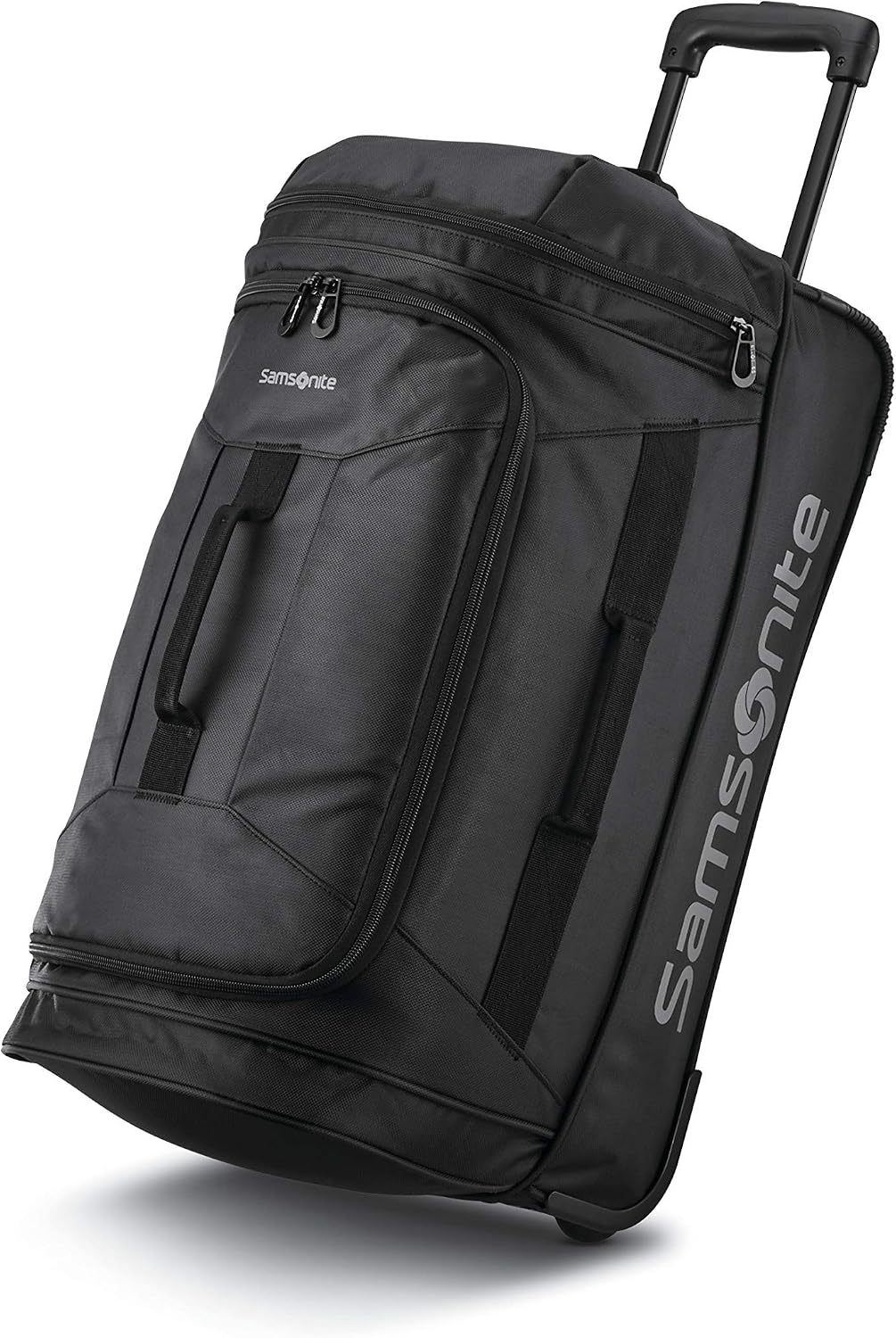
The all-purpose roller: Samsonite Andante 2 Wheeled Duffel Bag, 22-Inch Durable Rolling Luggage with Inline Skate Wheels, Push-Button Handle & Spacious Compartments, Travel-Friendly and Lightweight - All Black
 Visit on Amazon →
This is the duffel shape done the way I like it: 22-inch class, inline skate wheels, and a push-button handle, in a soft-sided body that weighs very little before you put anything in it. That last part is the whole argument for a duffel. The weight limit is a contract, and every ounce of bag weight is stolen from your packing. A soft-sided roller in this class leaves you more of your allowance for actual clothes than a comparable hard case.
The soft body also buys you forgiveness at the gate. A duffel that is not packed to the ceiling will compress, and a compressible bag fits a tight bin that a rigid case will not. The spacious compartments let you separate dirty laundry, shoes, or a wet swimsuit from everything else instead of bagging it in a hotel trash liner, which is what most people end up doing.
The tradeoff is structure. A soft duffel gives up crush protection, so anything fragile goes in the middle of the load, wrapped in clothing, not against the wall of the bag. Inline skate wheels are a two-wheel design, which means you tilt and pull rather than push it upright beside you. That is stable on carpet and rough pavement and less stable if you load the top heavy, so keep the weight low and over the wheelbase.
Flaws but not dealbreakers: A loaded duffel with no internal frame can sag in the middle when you carry it by the side handles, and the two-wheel stance puts some pull weight on your wrist over a long terminal walk.
Anyone who packs soft goods, travels for weekends and road trips, and wants maximum usable space per pound of bag should start here.
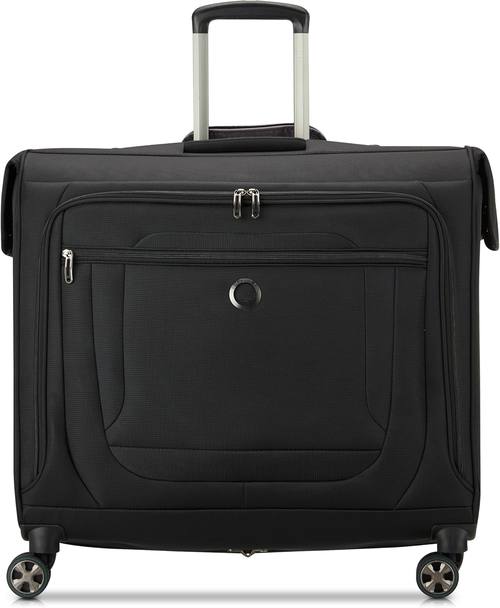
The wrinkle-free option: DELSEY PARIS Helium DLX, Rolling Garment Bag with Wheels, Black
 Visit on Amazon →
This is the bag for the trip where the clothes have to show up ready to wear. A rolling garment bag holds hanging items on their own hangers, folds once around them, and rolls on its own wheels so you are not carrying a folded bag over your shoulder through two terminals and a parking garage. The black shell reads as business travel without announcing itself, which matters if you are walking into a client meeting straight off a flight.
The case for a wheeled garment bag over a hard case with a garment sleeve is simple: the sleeve is an accessory you pack inside something else, and the garment bag is the bag. One item to manage, one thing to keep track of, one handle to grab when the bin is closing.
The tradeoff is volume. A garment bag carries hanging clothes beautifully and bulky gear badly, and it is an awkward shape in an overhead bin because it is long and flat rather than square. It also adds wheels and a handle to a category that used to be featherweight, so you feel the frame when you lift it overhead. If your trip is a wedding, an interview, a funeral, or a conference where you need one good outfit, none of that matters. If you are packing for a week of hiking, it is the wrong bag.
Flaws but not dealbreakers: The folded shape does not fit every bin in every aircraft the same way, so plan to board early rather than last.
Anyone who travels for work or events and needs hanging clothes to arrive wearable will get the most out of this one.
The packing and flying workflow
Now the part you came for. This works whether you are carrying the duffel, the garment bag, or both.
Step one: check your airline's current limit before you pack. Carry-on dimensions and weight limits change, and they differ by carrier and by fare class. Measure your bag yourself and do the linear inches math. Do not trust the number printed in the product listing, and do not trust the number a friend told you last year.
Step two: weigh the empty bag. Put it on a kitchen scale before anything goes in. That number is what you subtract from your allowance, and knowing it changes what you pack. A light duffel in the 22-inch class leaves you room for real clothes. A heavier bag forces you into decisions at 6am on departure day.
Step three: pack the garment bag first. Hanging items dictate the fold, so they set the shape of everything else. Button the jacket, use the hangers the bag is built for, and keep the pockets empty. Anything left in a jacket pocket becomes a lump that presses a crease into the fabric for the whole flight.
Step four: load the duffel in layers, heaviest at the bottom. Heaviest items sit against the back panel and over the wheelbase, closest to the wheels. That keeps the bag from tipping when you tilt it and keeps the weight off your wrist. Soft goods go around and on top of the hard items.
Step five: use the compartments for what they are good at. The side and top compartments are for the things you will need mid-trip: shoes, laundry, cables, a wet swimsuit. Packing those pockets first means you are not digging through folded clothes in a hotel room at midnight.
Step six: leave a little air. A bag packed to the zipper limit has no give. Leave a hand's width of slack so the zipper closes without a fight and the bag can compress into a tight bin. Zippers are the first thing to die, and every trip where you have to sit on the bag to close it is a trip off that zipper's life.
Step seven: test the bag before you leave the house. Extend the handle and shake it. Roll it across a hard floor and a rug. If the handle wobbles now, it will wobble worse after the belt. If a wheel rattles like a shopping cart on tile, you have time to deal with it before you are standing in a security line.
Step eight: know when to gate check. Small regional aircraft and full flights run out of bin space, and a gate-checked bag goes to the jet bridge, not to the carousel. If you are flying a regional jet, plan for it, keep your essentials in a personal item, and take the tag without arguing. The agents are not doing it to punish you. The bin is genuinely full.
Step nine: clean and inspect after the trip. Run a dry cloth along the zipper teeth, pull any thread or liner fabric out of the track, and spin the wheels by hand. Two minutes at the end of a trip is the difference between a bag that lasts five years and a bag that fails in year two.
What I did not put on this list
Hard-shell cases and four-wheel spinners are not bad bags. They are the right answer for a lot of travelers, and I have recommended plenty of them. They are the wrong answer for this particular job, for three reasons.
First, a rigid shell does not compress. If your bag is a quarter inch over the sizer, a soft bag squeezes and a hard bag does not, and the gate agent is not going to give you the benefit of the doubt. Second, a four-wheel spinner is wonderful on a smooth airport floor and miserable on carpet, cobblestone, and gravel, which is where a two-wheel duffel with inline skate wheels keeps rolling. Third, expandable cases tempt you to pack more than you need, and the bag you overpack is the bag you check.
I also left out luggage sets. A set forces you to buy a size you do not need, and the extra case lives in a closet until the one trip a decade where you drag it out. Buy the size you actually travel with, not the size you are tempted to buy. Oversized bags get checked, and checked bags get lost.
What this all costs
I am not going to quote you prices, because they move and I would rather you see the current number yourself. Check current Amazon price on each bag before you decide.
What I can tell you is the shape of the math. The wheeled duffel is the lower-cost of these two by a wide margin, and it is the bag most travelers should buy first. The rolling garment bag costs more because it is a more specialized build, and it earns that money only if you actually travel with hanging clothes.
Run it as cost per trip. A duffel you carry on 20 flights a year for five years is a hundred trips, and the difference between a cheap bag that fails in year two and a good one that survives is measured in cents per trip, not dollars. The same goes for the garment bag if you fly for work. The number that actually costs you money is the replacement bag, plus the checked bag fee you pay when the cheap one breaks on the outbound leg of a two-week trip.
Buy the shape that matches your trips, pack it with a plan, and measure it against your airline's current rules before you leave. That is the whole job. Your bag can do it. Let it.