Carry-on and duffle packing looks simple until you are standing at the end of a jet bridge with a case in one hand, a bag on your shoulder, and a gate agent telling you the bins are full. Then it stops being a packing problem and becomes a logistics problem, and the people who solve it are the ones who decided how to split their gear before they left the house.
I spent six years as a gate agent at O'Hare, and I have flown more than 120 segments a year for the last four. I have watched thousands of bags go down the belt and come back up scratched, cracked, or missing a wheel. The two bag setup in this article is what I would hand a normal traveler with a five day trip and a middle seat: a softside carry-on spinner as the base, a foldable duffle as the overflow and the second leg.
The rule that makes it work is simple. The case carries the weight. The duffle carries the volume. Get that backwards and you are the person repacking at the gate while the line stares at you.
Why you should trust me
I judged bags the way the belt judges them, which is to say without sentiment. Six years at the gate taught me what actually fails, and it is always the same three things in the same order: zippers, then handles, then wheels. Everything else is marketing.
Now I fly 120 plus segments a year and keep 11 bags in active rotation, and I still measure every case against the actual bin sizes of the US fleet before I recommend it. I test wheel noise on tile and carpet. I check handle wobble with the bag loaded, not empty. I check whether the zipper catches the liner when the bag is stuffed, because that is the failure that strands you in a hotel room with a bag that will not close.
I do not care what a bag looks like in a product photo. I care about linear inches, wheelbase, empty weight, and whether the thing survives being thrown. Those are the only numbers that decide whether your trip is easy or expensive.
How I picked and how I tested
Straight answer first: I have not run these two specific bags through my own five flight rotation, so I am not going to pretend I did. What I did is read both picks against the same checklist I used at the gate, and against the job this setup actually has to do on a five day trip.
That checklist has five questions. Does it fit the dimensions the airline currently publishes for your fare? Does the empty weight leave you enough room under the limit? Does the handle wobble when the bag is loaded? Do the wheels roll straight on tile and carpet without rattling like a shopping cart? Does the zipper run clean when the bag is full?
The reason softside wins this particular assignment is the same reason it always won at the gate. A soft bag compresses into a tight bin. A hard shell does not. If you fly regional jets, or a full 737 at 6 a.m., compression is the whole game, and the difference between a bag that slides in and a bag that gets gate checked.
Two bags, two jobs. Here is how each one reads against that checklist.
What you need before you start
Before you buy anything, check the current published limits for your airline and your fare. Carry-on dimensions and weight limits change, they differ by carrier and by fare class, and no article written months ago can tell you what your airline enforces on your travel date. Go to the carrier's own site and read the page yourself.
The numbers that matter are linear inches and empty weight. Linear inches is length plus width plus height, and it is the number the sizer is built around. Empty weight is the number people ignore. A heavier case eats your allowance before you pack a single shirt, so weigh the empty bag on a kitchen scale, write the number on a piece of tape inside the lid, and remember it.
Then measure the bag yourself, with a tape, including the wheels and the handle. Cases get advertised at one size and measure larger in the real world, and the sizer at the gate has no interest in the marketing copy. If a listing says 22.75 inches, that three quarters of an inch is exactly the kind of detail that gets a bag gate checked on a full flight.
Now the two bags.
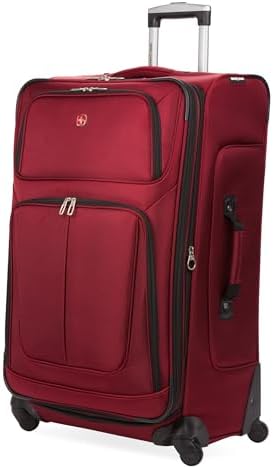
The base bag: SWISSGEAR Sion Carry-On Spinner Luggage, Softside Expandable, Lightweight Suitcase, Blue, 22.75-Inch
 Visit on Amazon →
This is the base bag, and the base bag is the one that has to fit the bin. The Sion is a softside spinner with an expandable main compartment, listed at 22.75 inches, which sits right at the edge of what most US carriers publish for a carry-on. Measure it yourself before you commit, and check the sizing note on the listing carefully.
Softside plus expandable is the combination I want for this job. The fabric flexes when the bin is tight, which is the difference between sliding in and gate checking. The expansion zipper buys you a couple of inches of depth on the return trip, when you have bought one more thing than you planned for.
The trade is structure. A soft case will not protect a laptop the way a hard shell will, so the electronics go in the duffle, padded, and the case carries clothes.
Spinner wheels are the other thing to know. Four wheels roll beautifully across a terminal floor and they are worth it if you spend your travel days in airports with smooth floors. On cobblestones, gravel, and old European sidewalks, a spinner is a nuisance. Tip it onto two wheels and pull it behind you.
Check current Amazon price before you decide, and verify the linear inches against your airline's current rules rather than against a photo.
Flaws but not dealbreakers: Expandable does not mean unlimited. Unzip the expansion and the bag gets deeper, and depth is the dimension the sizer measures first. Use it on the way home, not on the way out.
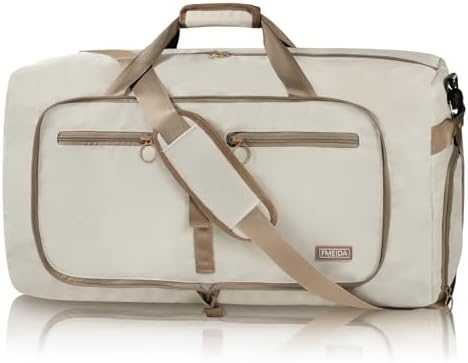
The second bag: Fmeida 65L Duffle Bag Foldable Travel Duffel Bags for Men Women Travel Bag
 Visit on Amazon →
The duffle is the volume bag, and 65 liters is a lot of volume. That is the point of it. Packed full, it is not a personal item and it is not a carry-on, it is a checked bag or an overflow bag for the trip where you come home with more than you left with. Folded flat, it takes up almost nothing in the bottom of the case, which is the reason it belongs in this setup at all.
Think of it in three modes. Flat, it is a spare bag for the return leg. Half full with soft goods, it is the personal item under the seat in front of you, and it keeps the case light enough to stay in the bin. Full at 65 liters, it is a checked bag and you should treat it like one.
Because it is unstructured, everything that goes in it needs to be soft. Jackets, laundry, a pair of shoes wrapped in a plastic bag. That is the load. Do not put a laptop in a soft duffle and hand it to a ramp crew, and do not pack anything fragile in it if you plan to check it.
Check current Amazon price on the listing, and look at the packed dimensions before you plan to carry it on. A duffle has no frame to hold a shape, so it fills whatever space you give it, including the space where your feet are supposed to go.
Flaws but not dealbreakers: No wheels, no handle, no structure. It is a bag you carry, not a bag you roll, and it gets heavy fast once it is more than half full.
The actual packing workflow
Here is the order I would run, start to finish, the night before a five day trip.
Step one: check the airline's current rules. Go to the carrier's site, find the carry-on page for your fare, and write down the dimensions and the weight limit. Do this every trip. Rules change, and the gate agent has to enforce the version that is current on your travel date, not the version you remember from last year.
Step two: measure and weigh the empty case. Tape measure for the outside dimensions, including wheels and handles. Kitchen scale for the empty weight. Write both numbers down. If the case is over the published dimensions or heavier than you expected, you have a decision to make at home instead of at the gate.
Step three: pack the case first. The case is the weight bag. Heaviest items low and toward the spine, which is the side closest to the handle. Shoes on the bottom, then jeans and bulky layers, then the lighter things on top. Packing cubes are the best purchase under fifty dollars in travel, not because they save space but because they let you find the one thing you need at 3 a.m. without unpacking the whole bag onto the hotel carpet.
Step four: keep the duffle flat until you know what is left. Do not fill the duffle first. Fill the case, weigh it, and see what remains. If everything fits in the case, the duffle rides flat and you have a one bag trip, which is the best version of this setup.
Step five: load the duffle with soft goods only. Jackets, a change of clothes, laundry, the layer you want on the plane. If the duffle is your under seat bag, keep it around two thirds full at most so it can compress into the footwell.
Step six: wear your heaviest layer. The boots and the coat do not count against a carry-on limit if you are wearing them. That is not a trick, it is just how the rules work.
Step seven: do a carry test in your hallway. Loaded case in one hand, duffle on the shoulder, walk fifty feet and back. If the handle wobbles or the strap digs into your neck, fix it now. You will be doing that walk for real, on tile, at 5 a.m., with a coffee in the other hand.
Step eight: decide the gate check plan before you reach the gate. On a full flight the gate agent will offer to check bags at the door. That is usually free and usually fine, but anything you cannot lose goes in the duffle that stays with you. Medications, documents, electronics, one change of clothes. The case can go down the jet bridge. Your trip does not end if it does.
Where this setup breaks down
A few honest caveats before you buy.
Softside cases do not protect fragile items. If you carry a camera or a laptop, the padded duffle is where it goes, and it does not leave your side.
The expandable zipper is a temptation, not a free upgrade. Expanding the case makes it deeper, and depth is the dimension the sizer measures first. Use it on the way home, not on the way out.
Spinner wheels and rough ground do not get along. If your trip is mostly cobblestones, train platforms, and gravel, a two wheel bag or a backpack will treat you better than a four wheel spinner.
And a 65 liter duffle carried full is a checked bag no matter what the listing says. If you would not hand it to a ramp crew, do not pack it that way.
What this all costs
I am not going to quote prices here, because they move and a stale number helps nobody. Check current Amazon price on both listings and compare the total against what you would spend on checked bag fees over two or three round trips. That is the real comparison, and for most people the pair pays for itself in a couple of trips.
The other half of the math is weight. Every ounce of empty case weight is stolen from what you can pack, so a lighter case is not just easier to carry, it is more capacity under the same limit. That is why I look at empty weight before I look at anything else on a spec sheet.
Five years on a case you actually keep works out to pennies a day. A bag that gets gate checked and never comes back costs you the whole trip, and no warranty makes that afternoon better.
The split is the whole trick. Case carries the weight, duffle carries the volume, and the duffle stays flat until you know exactly what is left. Do that once and you will never go back to packing in a single oversized bag you were tempted to buy and never needed.