Every bad travel day starts with the same mistake: the bag split. People pack the carry-on like a checked bag and the checked bag like a closet, then stand in the aisle hauling forty pounds over their head while the flight attendant watches with the patience of someone who has seen this exact scene twice before lunch.
I spent six years as a gate agent at O'Hare. I have watched thousands of bags get stacked, dropped, gate checked at the last minute, and occasionally sent to a city the passenger was not visiting. What that job taught me is that packing a carry-on and a checked bag is not a volume problem. It is a weight problem, a control problem, and a "which bag am I willing to lose for a day" problem.
The split below is the one I would use for a two-week trip. It assumes one soft carry-on that passes the sizer and one medium checked spinner, and it assumes you would rather carry less than pay more.
Why you should trust me
Six years on the ramp and at the gate at O'Hare, then four years writing about luggage full time while flying more than 120 segments a year. That is the whole resume, and it is the only reason anyone should listen to me about bags.
I have watched a hard shell come down the belt with the corner split open and the passenger's clothes riding the carousel behind it. I have watched a soft duffle get wedged into a bin that a hard case would not fit into, because fabric gives and polycarbonate does not. I have also watched a handle snap on a bag that cost more than my first car, on a trip where the owner had bragged about it in the boarding line.
I do not care what the ad photo looks like. I care about four things: what the bag weighs empty, whether it fits the sizer, whether the wheels survive a tile floor, and whether the zipper is still smooth after twenty flights. Everything below comes back to those four.
How I picked the two bags for this split
The gear here is not a "best bag" list. It is two roles, and the roles are the point.
A carry-on for this plan has to do one job: pass the sizer. That means the outer envelope matters more than the brand, and it means wheels are the enemy. A wheeled case that measures 22 inches on the spec sheet has to fit its wheels and its handle inside the same box the airline measures, and the sizer does not care about your spec sheet. A soft bag compresses into the gauge. A hard bag either fits or it does not, and "does not" costs you a gate check fee at the worst possible moment.
A checked bag for this plan has to survive being treated like cargo. It gets stacked, thrown, and dropped from height onto a belt. The shell takes that beating instead of your clothes, and the wheels have to roll straight when the bag is loaded to fifty pounds.
For each role I looked at linear inches first, then empty weight, then the parts that fail. Zippers are the first thing to die on any bag. The second is the handle. If both survive twenty flights, the bag was worth the money, and that is the only durability test I trust.
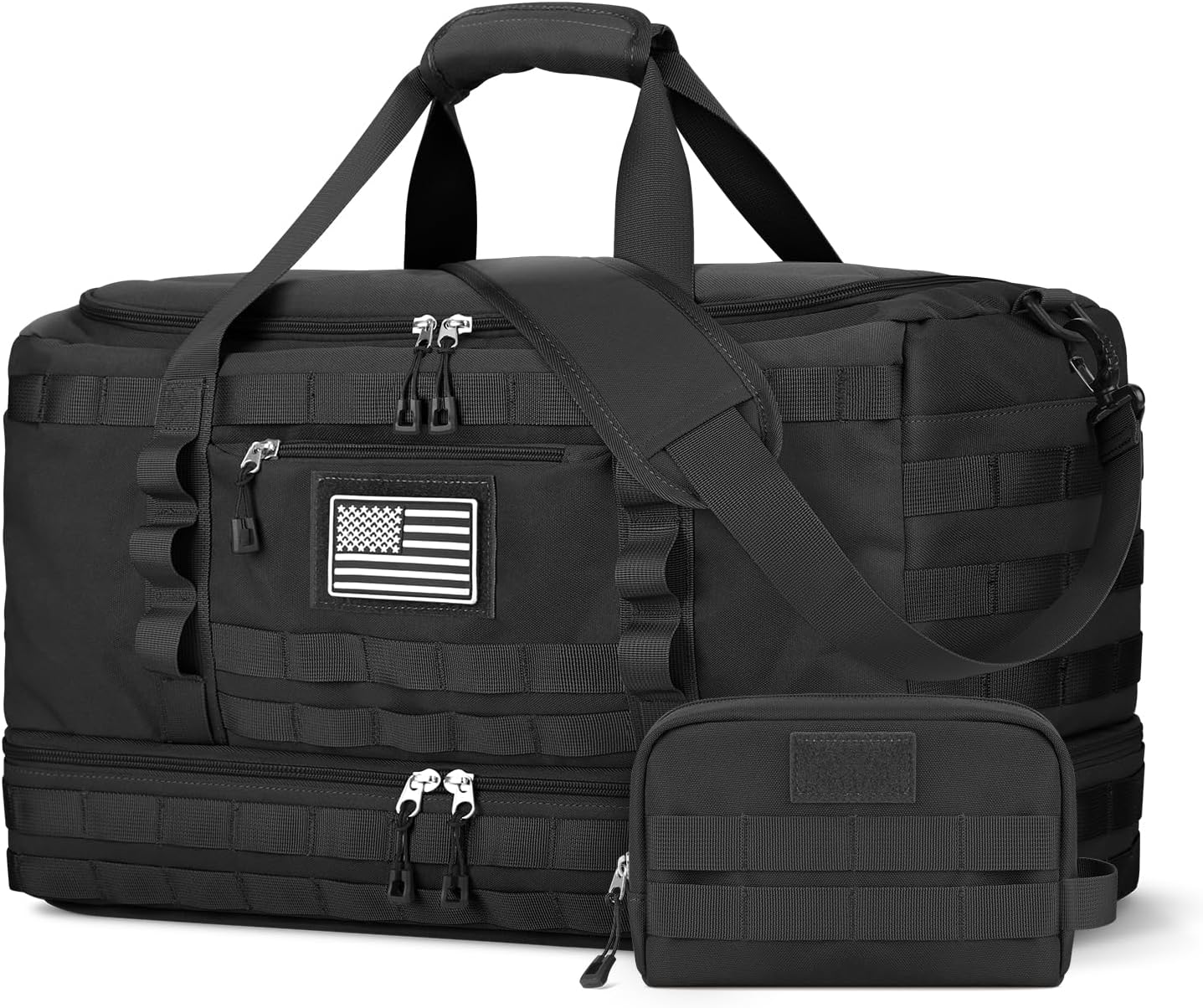
Carry-on pick: Gym Bag for Men Women, Carry on Luggage 22x14x9 Airline Approved Duffle Bag
 Visit on Amazon →
This is the bag I point people to when the priority is passing the sizer, not winning a style contest. The name tells you the envelope: 22 by 14 by 9, which is the number most US carriers publish for a main cabin carry-on. The reason it works is that fabric does not argue with a sizer the way a hard shell does. Load it full, push the sides in, and it slides into the gauge.
What you give up is your back. There are no wheels here, so this bag lives on your shoulder from the curb to the overhead bin. On a short trip that is nothing. On a connection through a hub the size of O'Hare, you will feel every pound of it by the second concourse.
The other tradeoff is structure. A soft duffle has no frame, so it slumps when it is half empty, and it offers zero protection for anything fragile. If you carry a laptop or a camera, that goes in the personal item under the seat, not in here.
Check current Amazon price before you commit, because softside pricing moves more through the year than hard shell pricing does.
Flaws but not dealbreakers: No wheels and no rigid frame. If you have a bad shoulder or a long walk between gates, a spinner is the kinder choice and you will pay for that comfort at the sizer.
Anyone flying a fare that charges for every checked bag, or anyone who wants the smallest footprint in the overhead, gets the most out of this bag.
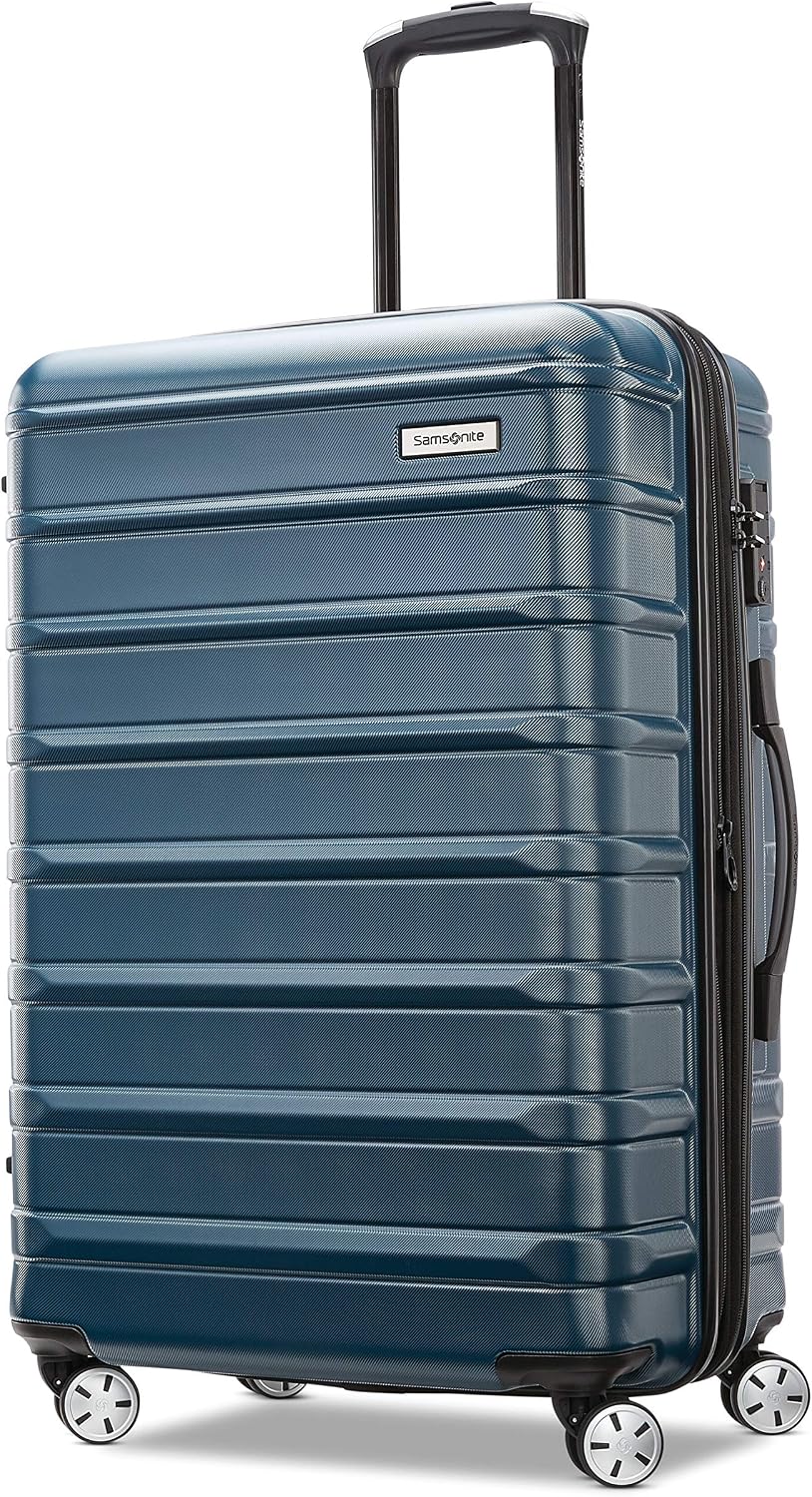
Checked pick: Samsonite Omni 2 Hardside Expandable Spinner Wheel Luggage, Checked Medium 24 in, Nova Teal
 Visit on Amazon →
The other half of the split is the bag you hand over at the counter. A 24-inch hardside spinner in the checked medium class is the size that generally keeps you inside the 62 linear inch limit most US carriers publish, and it is the size I would choose for two weeks of clothes plus a pair of shoes. It is not a carry-on on any carrier I know of. Anyone who tells you a 24-inch case is a carry-on has not stood at a gate with a sizer in front of them.
Hardside means the shell takes the beating instead of the contents, which matters when the belt drops the bag from height. It is also expandable, and the expandable zipper buys you depth on the return leg when the souvenirs go in. Use that feature sparingly, because an expanded bag is a bigger bag, and a bigger bag is one that may not fit a return sizer if you end up gate checking it.
The tradeoff, and I will keep saying it, is that polycarbonate cracks at the corners when it lands wrong. It does not tear and spill the way fabric does. It splits. That is the price of the protection, and it is why I would still put the irreplaceable things in the carry-on.
One practical note on Nova Teal: this is the loudest object in the article. That is a feature at the carousel, where a bright bag is easy to spot from twenty feet, and a drawback if you would rather your luggage not announce itself in a hotel lobby.
Check current Amazon price, since hard shell pricing in this class moves with the season.
Flaws but not dealbreakers: Hard shells scuff and show it, and the expandable zipper is one more seam to fail. The 24-inch class also guarantees you are paying checked bag fees on every trip, so factor that in before you buy the bigger bag.
Anyone taking a two-week trip, or anyone who packs shoes and bulky layers, will get more out of this than out of a second carry-on.
The actual packing workflow
Now the part you came for. This works with any two bags, not just the two above.
Step one: Confirm your fare's allowance before you pack anything. Most US main cabin fares include one carry-on and one personal item, and checked bags are a fee each direction. Basic economy sometimes excludes the full-size carry-on entirely. Packing before you check the rules is how people end up paying a gate check fee they never needed to pay.
Step two: Weigh both bags empty and write the number down. A luggage scale or a kitchen scale works. Domestic checked allowances are commonly 50 pounds, and many international routes use 23 kilograms, which is close to the same number. The empty weight of the bag is the part you cannot change at the airport, so a heavy empty case steals from your allowance before a single shirt goes in.
Step three: Pack the checked bag first, then top off the carry-on. Doing it in that order means the overflow has somewhere to go. Do it the other way and you end up with a checked bag under the limit and a carry-on you cannot lift into a bin.
Step four: Split by weight, not by category. The checked bag is limited by the airline's scale. The carry-on is limited by your shoulder. Dense, heavy, small items go in the carry-on, right up to the point where you can still press it overhead without help. Bulky, light items go in the checked bag, where the weight limit is the binding constraint.
Step five: Every liquid over 3.4 ounces goes in the checked bag. The carry-on gets the quart bag of small bottles, and it comes out at security, so pack it on top of everything else. Digging for it at the belt is how you lose a boarding group.
Step six: Leave room in both bags. Fifteen percent empty is the right target. Laundry, souvenirs, and the jacket you shed in a warm terminal all need somewhere to live.
Step seven: Put a card inside each bag with your name, phone number, and destination. Outside tags fall off, and the inside card is the thing that gets a bag back to you. Photograph the packed contents too, because an inventory makes a claim easier if the bag goes missing.
Step eight: Respect the sizer at the gate. The sizer includes your wheels and your handle. If the bag does not slide in without you shoving it, it is a checked bag, and you will pay the gate fee for it. Wear your bulkiest layer onto the plane instead of packing it, and put the carry-on in the sizer with the soft side first so the fabric can give.
What goes in which bag
Carry-on: travel documents, medications, one full change of clothes, chargers and cables, the quart bag of liquids, and anything you would panic about losing. If the checked bag vanishes for a day, this is the bag that keeps the trip alive.
Checked bag: shoes, full-size toiletries, bulky layers, the second week of clothing, and anything you could replace at a drugstore if it never shows up.
Personal item: the thing that lives under the seat in front of you. That is where the laptop goes if you want it reachable, because the overhead bin is not a place you want to open mid-flight.
The competition and why it lost
This is normally where I name the bags that did not make the cut. The honest version is that the category matters more than the badge.
A four-wheel underseat roller is a fine bag and a poor choice for this plan. It eats your foot space and it still has to go in the bin on a full flight. A softside spinner is the most forgiving checked bag you can buy and the wrong pick if you are flying a fare that charges for every check, because you will pay it twice a trip. A backpack is the right answer for a weekend and the wrong answer for two weeks of shoes. A hard 20-inch international-size case is a beautiful thing that will not hold two weeks of anything, which is exactly why the split in this article exists: one soft bag you keep, one hard bag you hand over.
None of those are bad bags. They are just answers to different questions.
What this all costs
The carry-on is the cheap half of this plan and the checked bag is the expensive half, but the number that actually hurts is the fee, not the bag. A checked bag fee paid both directions is the real recurring cost, and it recurs on every trip, which is why the bag you buy matters less than the number of trips you take.
Both bags here move in price through the year, and the duffle in particular swings with the season. Check current Amazon price on both before you buy, then compare that against what a single round trip of checked bag fees costs you.
The math that matters: a bag that survives twenty flights cost you almost nothing per trip. A bag that fails at the handle on flight three cost you full price plus whatever you had to buy at the airport to replace it, at airport prices, with no time to shop around.
The last thing
Pack the split, weigh both bags on the way out and on the way home, and keep the receipts for the fees. The airline will treat your checked bag like it is disposable, so the only real protection you have is deciding what goes inside it before you get to the counter.
Your carry-on is the bag that gets you through the first 24 hours. Pack it like that, and the trip can survive almost anything the belt does to the other one.