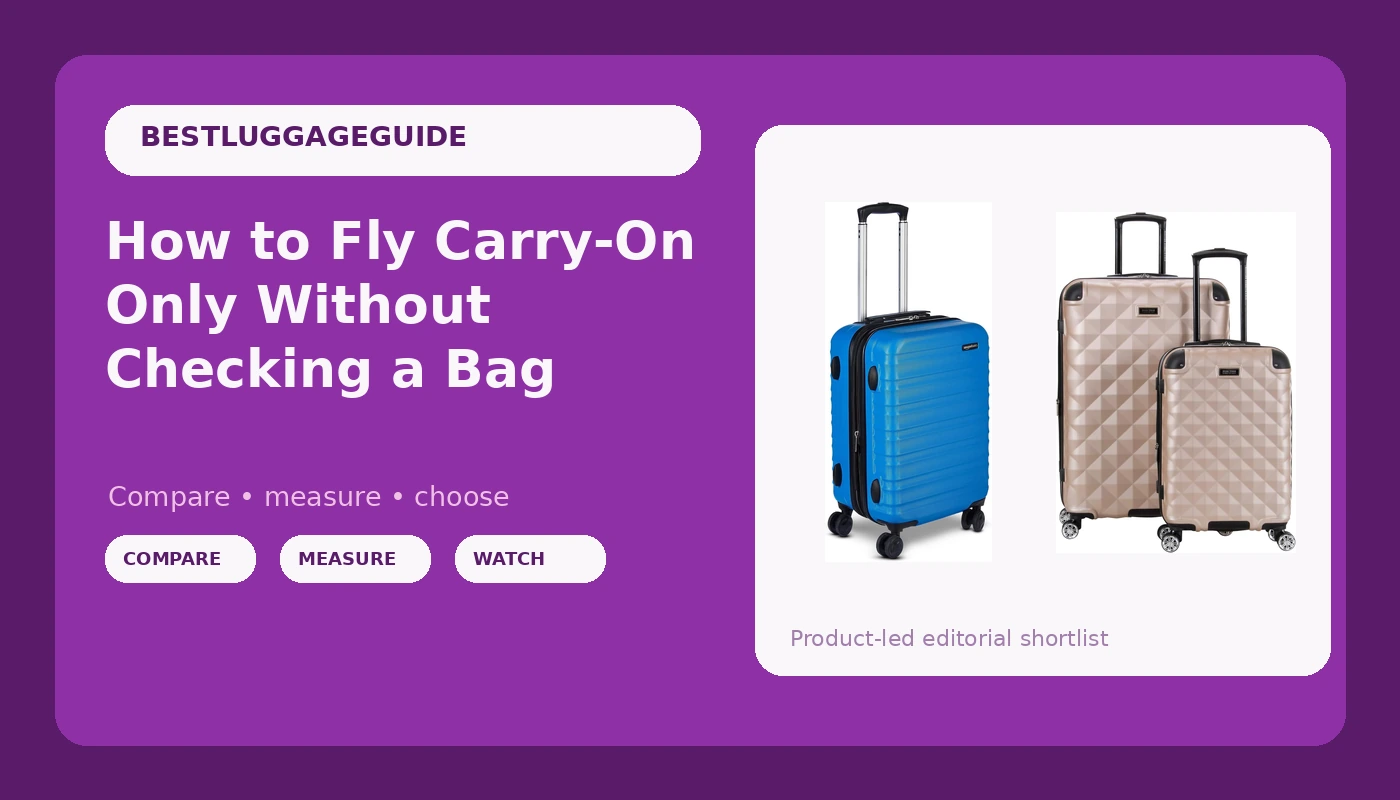
There is a specific moment at the gate that tells you who is going to have a bad day. It is when the agent calls the last boarding group and half the line is still standing there with a roller that will not fit. I worked the counter at O'Hare for six years, and I can tell you that flying carry-on only is not a personality trait. It is a measurement problem. Get the hardside carry-on luggage right and the rest of the trip takes care of itself.
The bag that fails is almost never the bag that was too big on paper. It is the bag that was fine on paper and too big once it was packed, expanded, and stuffed into a bin that was already two-thirds full of someone else's coat. The airline did not change the rules on you. You changed the size of your bag.
What follows is the method I used on the ramp side of the counter, plus the two cases I would actually point a normal traveler toward. One is a single carry-on. One is a set for people who genuinely check a bag.
Why you should trust me
I spent six years as a gate agent at O'Hare before I started reviewing bags full time, and I have flown more than 120 segments a year for the last four. I keep eleven cases in active rotation. I have watched thousands of rollers go down the belt and come back up, and the failures are boringly predictable: a zipper gives out, a handle starts to wobble, a shell cracks at the corner where the belt dropped it wrong.
I judge every case the way I did at the gate. What survives the belt, what fits the bin, and what the airline will not fight you about.
How I judged these two bags
I did not fly these two specific cases myself, so I am not going to pretend I did. What I can do is read them against the same checklist I used when a passenger asked me whether their bag would make it on. Linear inches, wheelbase width, handle wobble, shell construction, and how much the expansion zipper gives away. That checklist is short because the answer at the gate is usually short. A bag either slides into the sizer or it does not.
Linear inches is the number to learn. Add length plus width plus depth. Airlines publish their carry-on limit as those three numbers, and the number on the product listing is not the same thing. A case sold as a 21 inch carry-on is describing the shell, not the whole bag with wheels and handle extended. The wheels on a spinner add height that nobody counts until the sizer does.
Wheelbase matters more than people think. A four-wheel spinner with single casters has a narrow footprint, and a narrow footprint tips when you push it fast across a jet bridge seam. Dual casters, the kind that add up to eight wheels on a bag, widen the base and hold a straight line.
Handle wobble is the first thing I check and the last thing buyers mention. Grab the extended handle and twist. If it flexes before the first flight, it will rattle by the tenth.
The bags that make carry-on only work
Two very different answers to the same question. One is a single carry-on that keeps you out of the checked bag line entirely. The other is a set for travelers who really do check a bag on longer trips.
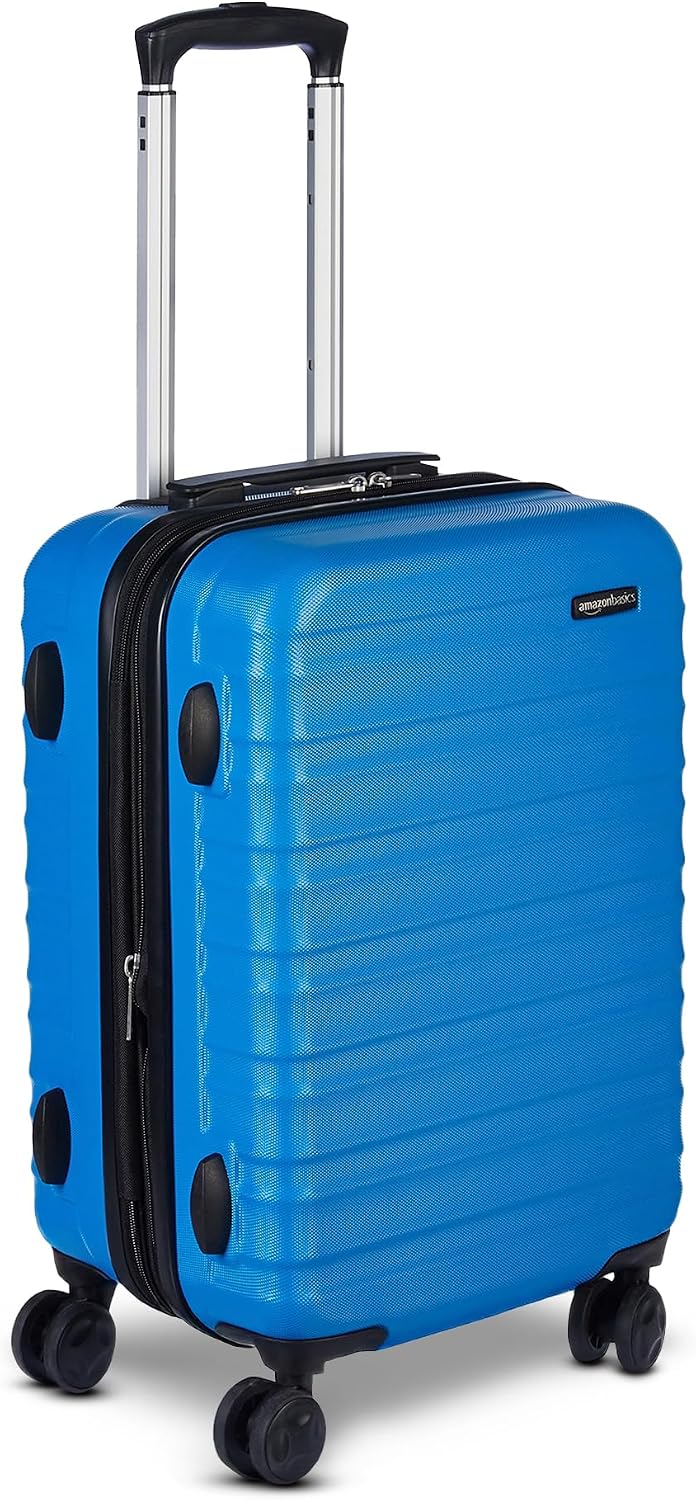
Budget pick: Amazon Basics 21" Hardside Carry-On Luggage with Expandable Space, Scratch-Resistant Surface, Telescoping Handle, Four Multi-directional Wheels, Light Blue
 Visit on Amazon →
This is the case I point people toward when they want a first carry-on and do not want to spend a lot learning what they actually need. It is a 21 inch hardside with a scratch-resistant finish, a telescoping handle, and four multi-directional wheels. The expandable zipper is the feature worth talking about. It buys you extra depth on the trip home, when you are carrying more than you left with.
That expansion is also the trap. Expanded, the bag is no longer the carry-on you measured in your hallway, and a full flight is exactly when a gate agent has the least room to be generous. Pack it expanded, then close the expansion before you reach the sizer. If it will not close, you packed too much.
The light blue shell is going to show scuffs, but scuffs are cosmetic. What matters is that a hard shell holds its shape under a stack of other bags, which is the whole argument for hardside in the first place.
Flaws but not dealbreakers: Four single casters mean a narrower wheelbase than an eight-wheel spinner, and the telescoping handle is the part I would watch over a few years of hard use. Neither is unusual at this tier.
This is the right bag for a traveler who flies a handful of times a year and wants one case that does the job without a learning curve.
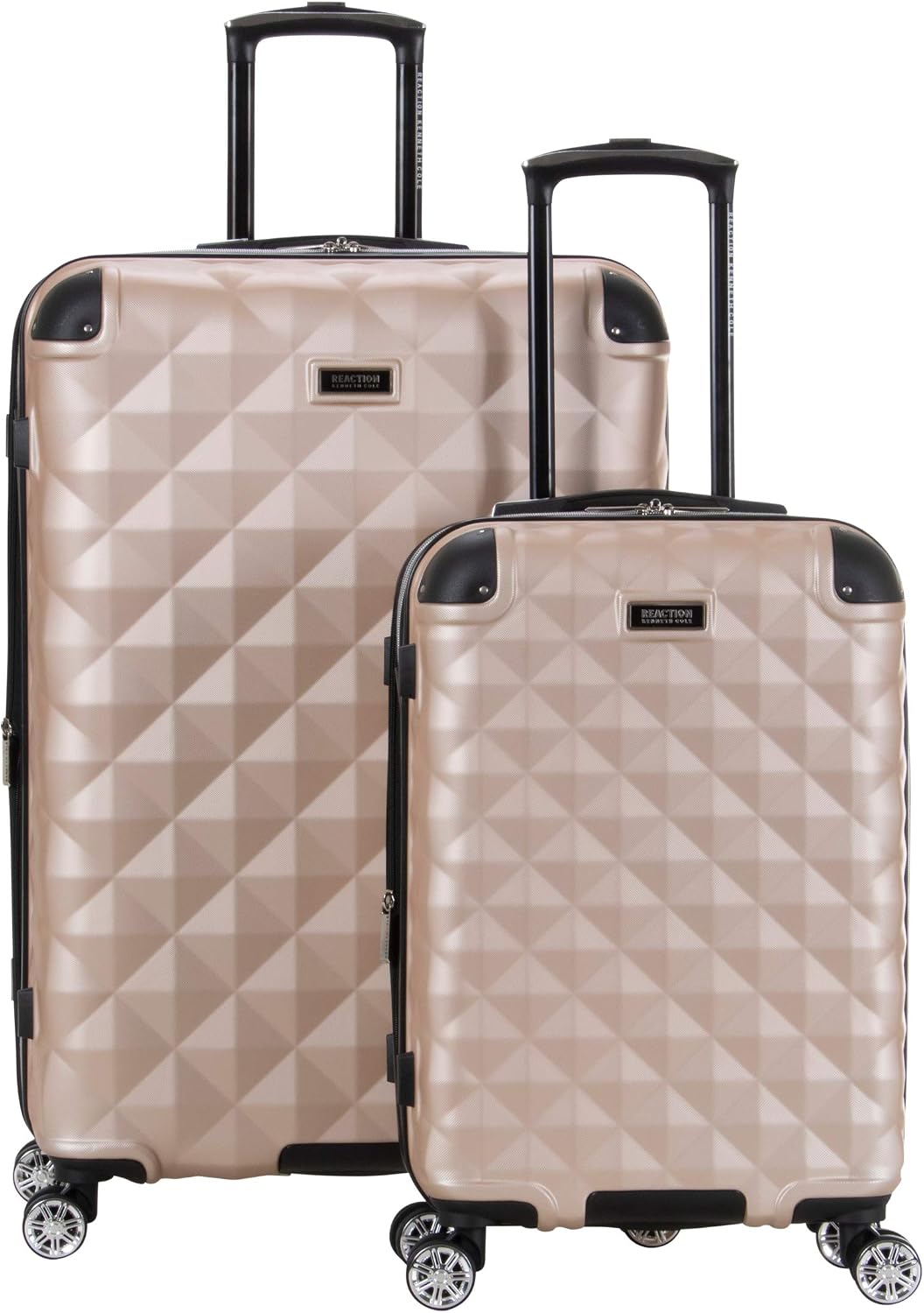
The two-bag pick: Kenneth Cole REACTION Diamond Tower Collection Lightweight Hardside Expandable 8-Wheel Spinner Travel Luggage, Rose Champagne, 2-Piece Set (20" & 28")
 Visit on Amazon →
Here is the honest read on a set, from someone who spent years watching sets come down the belt. The 20 inch case is your carry-on. The 28 inch case is a checked bag, full stop, and no amount of optimism changes that. If your trips run three to five days, you are paying for a bag that will live in a closet.
If your trips run two weeks, or you travel with a family and act as the pack mule, the math changes fast. Both cases are hardside and expandable, and the 8-wheel spinner setup means each bag rolls on four dual casters. That wider base is the difference between a case that tracks straight through a crowded concourse and one that keeps tipping toward your ankle. Rose champagne is a light finish, so expect scuffs to show early and clean them when they do.
Flaws but not dealbreakers: A set forces you to buy the size you did not need. That is the trade. You get a better per-bag value and a matching pair, and you accept that one of them sits idle most of the year.
Buy this if you check a bag at least a few times a year and want both sizes in one purchase. If you never check, put that money into a single carry-on instead.
The step-by-step method for flying carry-on only
Now the workflow. This is the same order I would walk a nervous passenger through at the counter, and it works with either bag above.
Step one: Measure the bag, not the label. Empty the case, extend the handle, and measure from the tallest point to the floor. Then measure length, width, and depth at the widest point, which is usually the wheels and the front pocket. Add those three numbers. That is your linear inches.
Step two: Check your airline's current carry-on limit. Do this the week you fly, not the week you booked. Limits and enforcement change, and the airline's own page is the only source that counts. Do not trust a blog post from three years ago, including this one. My rule: if the published limit and your measurement are within half an inch of each other, you are gambling.
Step three: Weigh the case empty. Put it on a luggage scale before you pack a single thing. Every ounce of case is an ounce stolen from your packing, and if your route has a carry-on weight limit, that empty number is the one you have to live with all week.
Step four: Pack heavy over the wheelbase. The heaviest items go at the bottom of the case, right above the wheels. A bag that is heavy at the bottom pushes straight. A bag that is heavy at the top leans on the handle, and a leaning bag is a wobbling handle waiting to happen.
Step five: Roll the soft stuff, do not fold it. Rolling clothes compresses them and keeps creases out. If you want a real upgrade, packing cubes are the best cheap purchase in travel. They do not save much space. They save your sanity at 3am in a hotel room when you are hunting for one sock.
Step six: Leave the top layer unstructured. That is where the jacket you shed at security goes, and it is where the souvenirs go on the way home.
Step seven: Wear your heaviest layer to the airport. The coat, the boots, the bulky sweater. It never touches the bag, and it never touches the scale.
Step eight: Close the expansion zipper before you leave the hotel. Expansion is for the trip home, and even then only if you are not fighting for bin space.
Step nine: Board when your group is called. Bin space is first come, first served, and the traveler who boards last is the traveler whose bag gets gate checked. If you have status or a card that boards you early, use it on full flights.
Step ten: Have a gate check plan. If the bin is full, a gate check is not a failure. It is a free checked bag that comes back to you on the jet bridge instead of the carousel. Pull the valuables and the lithium batteries out first, because those are not allowed in a checked bag, and get the receipt tag.
What did not make the list
Softside cases are still the practical choice for some travelers, and I will argue that all day. A softside with an external pocket holds more in the same footprint, and the fabric flexes when the bin is tight. The reason hardside dominates this article is simple. A hard shell protects what is inside from the stack, and the stack is what breaks things.
What I left out is the oversized carry-on. Anything marketed as a 22 or 23 inch spinner that measures over the published limit is a bag that gets gate checked on the flight where you needed it most. Buy the size you actually need, not the size you are tempted by.
And if you are shopping for a set, ask yourself one question first. Will you genuinely check a bag this year? If the answer is no, you are buying closet space.
What this all costs
I am not going to quote prices here, because they move and a stale number is worse than no number. Check current Amazon price on both listings and do the math against what you spend on checked bag fees in a year. That is the only comparison that matters.
The budget case is the lower-cost way in. The two-piece set costs more, but it covers a carry-on and a checked bag, so if you were going to buy two cases anyway, the set is the cheaper path to both.
Run those numbers once a year. Then stop shopping and start packing.
That is the job. Now go measure your bag.