Most carry-on advice starts with the wrong question. It asks which bag to buy, when the real question is how to split your load between two bags the gate agent will actually let on the plane. The carry-on duffel and spinner combination answers that better than any single case I have handled, and it does it without a checked bag fee or a stop at the lost luggage counter.
I spent six years as a gate agent at O'Hare, which means I watched how bags really travel: thrown down a belt, stacked four deep in a bin, dragged by one wheel across a jet bridge by someone who was already late. That job taught me that a two-bag setup is not a compromise. It is the strategy that keeps your stuff with you.
This is the workflow I would hand to a friend. Measure both bags before you buy anything, split the weight, pack the dense items low, and keep the soft bag soft enough to squish into the sizer when someone asks.
Why you should trust me
Six years at the gate, then four more flying more than 120 segments a year as a reviewer. I own 11 bags in active rotation and I judge every one the way I judged them at the counter: what survives the belt, what fits the bin, and what the airline will not fight you about.
I do not care what a case looks like in a marketing photo. I care about linear inches against the sizer, wheelbase stability when the bag is loaded, handle wobble before the first flight, and whether the zipper still closes on trip 20. I disclose press samples when I get them, and I do not make claims about airline policy without checking the current published rules, because those rules change and the person at the counter is reading the version from today.
How I picked and how I tested
The two bags below are not a matched set, and that is deliberate. A set forces you to buy a bag you do not need, usually the one that does not fit the bin. Instead, this is one personal item and one overhead bag, chosen so the pair covers a week of travel without a checked bag.
Here is the checklist I run on any bag before it goes in a guide. Linear inches first: length plus width plus height, measured by hand, because cases advertised at 21 inches have shown up at 23 more times than I can count. Then bin fit, which is a geometry problem, not a brand problem. Then wheelbase and wheel noise on tile and on carpet. Then handle wobble, loaded, at full extension. Then the zipper, because the zipper is the first thing to die and the handle is the second.
The short version of what I found: the soft duffel wins the personal-item slot because it can be squished into a sizer and has no wheels to fail, and the hardshell spinner wins the overhead slot because its footprint is predictable and it rolls through a jet bridge without drama.
The personal-item duffel you'll need before you start
A personal item is the bag that rides under the seat in front of you, and it is the single most valuable real estate in carry-on travel. Airlines rarely weigh it. It never gets gate checked unless the flight is truly full. And because it does not go in the bin, it does not have to be a rigid, rectangular object.
That is the whole argument for a soft duffel in this slot.
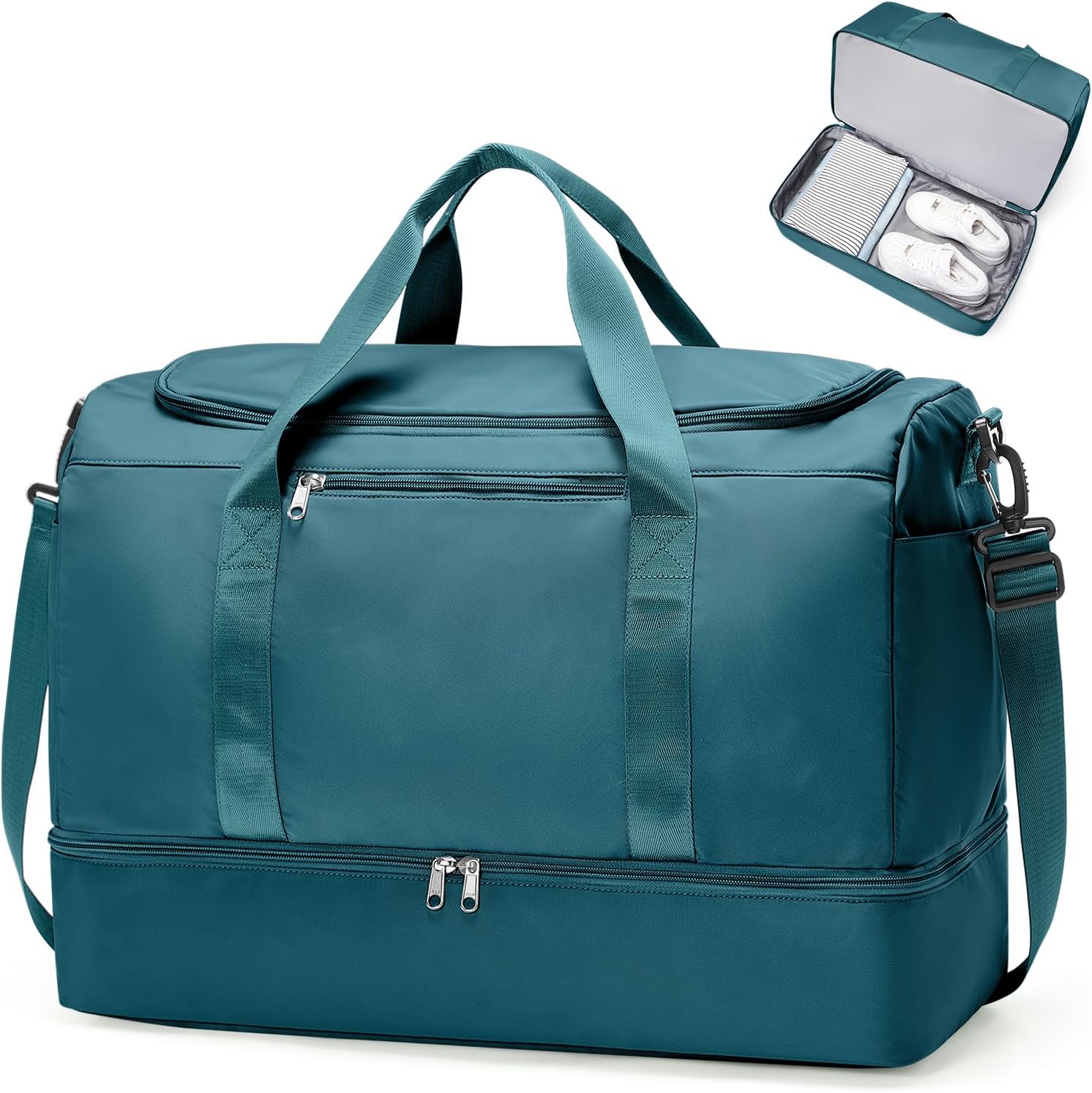
Our pick: Extra Large Travel Duffel Bag, Carry-On Weekender Bags for Women Travel
 Visit on Amazon →
This is the bag I would put in the under-seat slot. It is a soft-sided weekender, which means it has no shell to crack, no wheels to rattle, and no telescoping handle to develop wobble. Those are the three failure points I see most often at the gate, and this bag simply does not have them.
The soft construction is the feature, not a compromise. A duffel compresses. When a gate agent holds up the sizer and asks you to prove the bag fits, a soft bag gives you two inches you did not know you had, because you can push the sides in. A hard case either fits or it does not, and when it does not, you are paying a gate check fee and hoping the bag shows up at your destination.
Flaws but not dealbreakers: Soft bags offer almost no protection for fragile items, and a loaded duffel with a single shoulder strap gets heavy fast. Keep the dense stuff in the spinner and let this bag carry soft goods, layers, and anything you want within reach during the flight. Also treat the word "extra large" as a marketing word, not a measurement. Measure the bag yourself against your airline's current personal-item limit before you commit, because those limits vary by carrier and by fare class.
Anyone who wants a bag that disappears under the seat and never argues with a sizer will be happy here. If you need structure and protection, the spinner below carries that job.
The overhead-bin spinner that does the heavy lifting
The overhead bag is where the weight goes. It is also where the rigid geometry matters, because bin space is a fixed puzzle and a bag with a predictable footprint slots into it better than a soft bag that bulges wherever you stuffed a pair of shoes.
This is where a hardshell earns its place, and where a spinner earns its wheels.
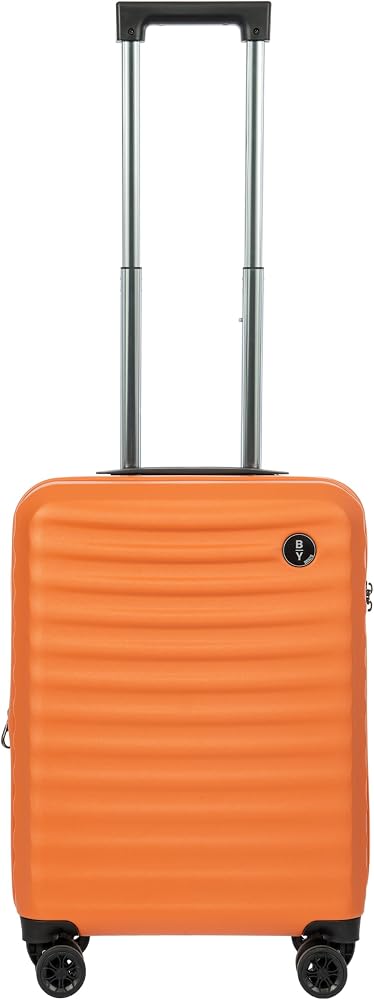
Our pick: Bric's Nausica 21" Expandable Spinner - Polycarbonate Hardshell Carry On Luggage, TSA Lock, Double Wheels, Orange
 Visit on Amazon →
This is the overhead bag in the pair. It is a polycarbonate hardshell carry-on with a TSA lock, double wheels, and an expandable main compartment, and the 21-inch class is the size that fits the widest range of US airline bins. Double wheels are the detail I care about most. A four-wheel spinner with paired wheels has a wider stance than a single-wheel spinner, which means less wobble when you are dragging it loaded across a jet bridge, and it rolls straight on carpet instead of fighting you.
The TSA lock matters for a different reason. It keeps a casual hand out of your bag without turning a routine screening into a cut zipper. It is not a security guarantee, and I would not put anything irreplaceable in a bag that leaves my sight, but it is the right default for the overhead slot.
The orange shell is a real, practical choice. It is easy to spot on a crowded belt and easy to describe to a baggage office if something goes sideways, which is worth more than a neutral color that blends into a sea of black cases.
Flaws but not dealbreakers: Polycarbonate shells crack at the corners when the belt drops them wrong. I have seen it more times than I can count, and a hardshell is not indestructible just because it is rigid. The expandable zipper is the other weak point: expansion buys you depth at the gate, but it can also push a compliant bag past the sizer, so treat it as an emergency lever, not a packing plan. And check the case's listed dimensions against your airline's current carry-on limit, because a bag sold as 21 inches is not automatically compliant with every sizer.
Anyone who wants a rigid overhead bag with a stable wheelbase and a lock will get the most out of this one. If you would rather squish than protect, the duffel above is your overhead bag instead.
The actual workflow, step by step
Now the part you came for. This works with a soft duffel and a hard spinner, and it works with almost any pair in those two roles.
Step one: Measure your airline's limit, not the bag's label. Look up the current published carry-on and personal-item dimensions for the specific airline and fare class on your ticket. Those numbers vary by carrier and they change, so do this the week you fly, not the week you book.
Step two: Measure both bags yourself. Length plus width plus height, in inches, by hand, with a tape measure. Include the wheels and the handle in the length. A bag that measures over the limit is a bag that gets gate checked, no matter what the product page says.
Step three: Weigh the empty spinner. Put it on a luggage scale before you pack a single item. Subtract that number from your airline's carry-on weight limit if it publishes one, and you have your real packing budget. Every ounce of case weight is an ounce stolen from your clothes. This is the single most skipped step in carry-on packing.
Step four: Load the spinner bottom-heavy. Shoes, toiletry kit, chargers, and anything dense go in first, near the wheelbase. A bag with its weight low rolls straighter and stands up when you let go of the handle. A bag with its weight high tips over in the aisle while you are trying to get your jacket off.
Step five: Keep the expansion zipper closed. Pack to the closed capacity. If you arrive at the gate and the bin is tight or the sizer is unforgiving, you have a lever left to pull. If you pack expanded, you have already spent it.
Step six: Build the duffel as a soft bag. Layers, jackets, soft-sided gear, snacks, anything you want under the seat. Keep it compressible. The moment a duffel gets rigid, you have lost the entire reason it is in the personal-item slot.
Step seven: Roll both bags loaded, on tile and on carpet. Listen for the shopping-cart rattle that tells you a wheel bearing is already tired, and check the handle at full extension for wobble. Do this at home, where a return is still an option, not in a jet bridge.
Step eight: Plan the gate check before it happens. Know what moves where if you are asked to check one bag. Medication, lithium batteries, and anything you cannot replace stay with you in the bag that does not leave your sight. Keep the lock combination or key accessible. Thirty seconds of planning beats ten minutes of repacking at the door of the aircraft.
The other approaches, and why they lost
A single large spinner loses because one bag has to do two jobs. The moment it is full, everything you want during the flight is in the bin above someone else's seat, and the bag itself is the one most likely to get gate checked when the flight is full.
A checked bag loses on risk, not on size. It is the version of travel where you hand your stuff to a system and hope. I have watched that system from the inside, and it works most of the time, which is exactly the problem.
A backpack-only setup is genuinely good for some trips, and it is the right call for a weekend where you will be walking a lot. It loses when you need structure, when you are carrying anything that should not be crushed, or when your shoulders have opinions about 20 pounds.
A two-wheel softside is the old reliable, and it is not wrong. It just does not have the wheelbase stability of a spinner on tile, and it does not have the predictable footprint of a hardshell in the bin.
The duffel plus spinner pair wins because each bag is doing the job it is actually good at. Soft where compression helps, hard where protection and geometry help.
What this all costs
I am not going to print a number here, because listings move and a price in an article is stale by the time you read it. Check current Amazon price on both product pages and compare it against what you would otherwise spend.
The math that matters is not the sticker. It is the cost of the alternative. Checked bag fees vary by airline, fare class, and route, and they are charged per bag, per direction, on every trip. Run that against a one-time purchase and the two-bag setup pays for itself quickly, before you count the value of never standing at a baggage office filling out a claim form.
The other number to think about is weight. A lighter case means more of your allowance goes to actual stuff, and a soft duffel means the personal item slot costs you almost nothing in case weight. That is the whole design of this setup: spend the rigidity where it protects, spend nothing where it does not.
Buy the duffel, buy the spinner, measure both against your airline's current published limits, and pack the spinner bottom-heavy with the expansion zipper closed. That is the job. Do it once and the two-bag carry-on stops being a gamble and starts being the way you fly.