Carry-on luggage and travel gear is a category where the marketing runs well ahead of the reality. Every listing promises the same three things: it fits every overhead bin, it survives every baggage belt, and it weighs almost nothing. At the gate, those claims get tested thousands of times a day, and the failures repeat in the same order. Handles wobble before the first flight. Zippers catch the liner on the second. A shell that looked indestructible in a studio photo cracks at a corner when the belt drops it wrong.
The useful question is not which bag is best. It is which bag matches the trip you actually take. A business traveler who needs a softside that swallows a jacket, a one-bag traveler who wants 50 liters on their back, and a day-tripper who needs a locking sling for a passport and two cards are not shopping for the same product. This guide covers four options, what each one is built for, and the measurements that decide whether any of them boards with you.
Related: How to Measure a Carry-On Against Any Airline's Bin Gauge →
Quick answer
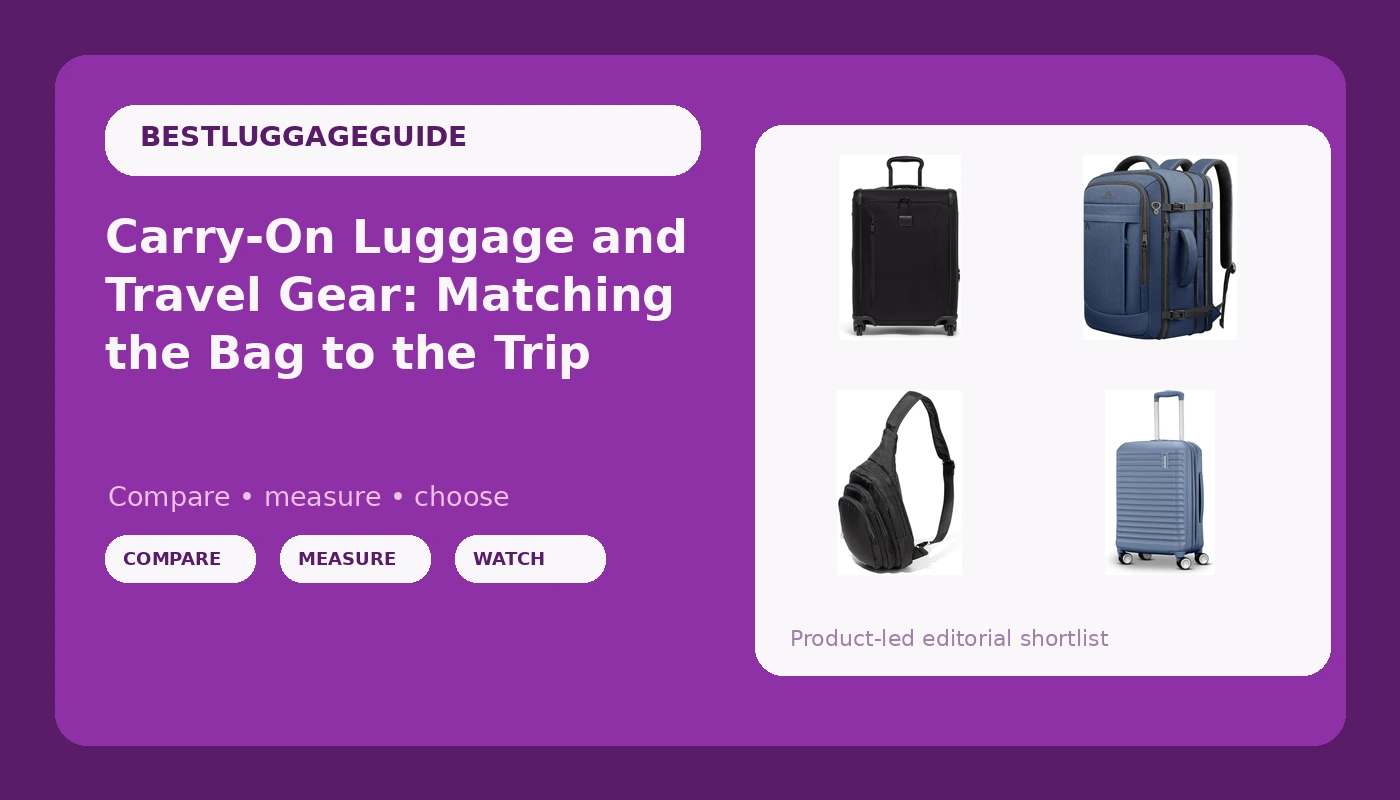
There is no single best carry-on for every traveler, and any guide that names one is selling something. The right pick depends on how you pack and where you sit. For a first carry-on or a budget replacement, the American Tourister Stratum 3.0 Carry-On Spinner is the value entry, with a hardside shell and a 1.5 inch expansion. For business travel and a premium expandable softside, the TUMI Aerotour 4 Wheel Expandable Luggage sits at the high end. For one-bag trips where you want your hands free, the AREYTECO Large Travel Laptop Backpack is the volume play at 50L. And for a personal item that keeps cards and documents secure in a crowd, the Securtex Anti-Theft Multi Zip Sling covers the smallest slot.
Four useful options
| Model | Best fit | What stands out |
|---|---|---|
| American Tourister Stratum 3.0 Carry-On Spinner | First carry-on, budget replacement | Hardside shell, expands 1.5 inches, RightHeight adjustable handle |
| TUMI Aerotour 4 Wheel Expandable Luggage | Business travel, premium softside buyers | 21.75 inch Continental expandable carry-on, four-wheel design |
| AREYTECO Large Travel Laptop Backpack | One-bag trips, hands-free travel | 50L capacity with a dedicated laptop compartment |
| Securtex Anti-Theft Multi Zip Sling | Personal item and day bag duty | Locking zippers and RFID protection in an 8.6 by 15.2 inch body |
The value hardside: American Tourister Stratum 3.0 Carry-On Spinner
Hardside is the type of case that wins the visual argument and loses a few practical ones. A rigid shell spreads compression loads across the whole face, which is why a hardside protects a laptop or a camera better than fabric does. The trade-off is that the same rigidity transfers impact straight to the corners, and corners are where shells fail first. The expansion zipper is a second thing to think about: it adds capacity, but it also adds a seam that a baggage belt can catch. On a case in this price band, expansion is best treated as a return-trip convenience rather than something you pack to from day one.
The premium expandable carry-on: TUMI Aerotour 4 Wheel Expandable Luggage
This is the end of the range where you are paying for materials, hardware, and warranty terms rather than capacity. Softside earns its place in two situations: when you pack clothing that needs to compress rather than sit flat, and when you want external access without opening the whole case in a hotel lobby. The four-wheel base is the other meaningful difference. It costs you a little interior volume at the bottom, and in exchange the case tracks straight down an aisle with a finger on the handle instead of a wrist taking the load. The 21.75 inch measurement is worth checking against your airline's current published limits before you commit, because Continental sizing sits close to the edge on some carriers.
The one-bag option: AREYTECO Large Travel Laptop Backpack
Backpacks solve a problem that wheeled cases cannot: stairs, cobblestones, and the last mile. They create a different one, which is your back. A loaded 50L pack carries high and close, and the weight sits on your shoulders rather than trailing behind you on four wheels. That is a fair trade for a traveler moving through a city on foot and a bad trade for someone who spends the trip in airports with polished floors. The other thing to watch is depth. A backpack that is packed tight can get deeper than a wheeled case of the same volume, and depth is the measurement that decides whether a bag slides into an overhead bin or gets gate checked.
The personal item: Securtex Anti-Theft Multi Zip Sling
A sling is not a replacement for a carry-on. It is the bag that rides on your body while the carry-on rides in the bin. Locking zippers are a delay tactic, not a guarantee: they make a bag annoying enough to skip, which is the realistic goal. RFID blocking matters most in crowds where a reader can get within a few inches of your pocket, and it does nothing about a lost wallet. The multi-zip layout is the part that earns daily use, because it lets you keep a passport, a phone, and a transit card in separate pockets instead of one pile.
Prices and availability may change. Product images, names, and retailer links are matched to verified listings. No current price, rating, stock status, or measured result is stated here without current evidence.
Linear inches, bin fit, and the number that actually matters
Linear inches is the sum of a bag's length, width, and depth. Airlines publish limits in that format because a single number is easier to enforce at a gate than three separate ones. The trap is that the number printed on a listing is not always the number a gate agent will measure. Wheels, handles, and exterior pockets usually count, and a case marketed at 21 inches can measure well past that once you include the hardware hanging off the back.
Bin fit is the second half of the problem. Even a bag that meets the published limit can fail to fit a specific aircraft's overhead bin, because bin depth varies by plane and by row. The practical approach is to know your case's real linear inches, packed and expanded, and to check your airline's current carry-on page before you fly rather than trusting the word "approved" on a product listing.
Weight is the third number. A carry-on allowance is a contract, and every pound the empty case weighs is a pound you cannot pack. A heavier case with more structure protects what is inside it; a lighter case lets you bring more. Neither is wrong, but you should decide which one you are buying before the case arrives.
Hardside, softside, backpack, or sling: what each type is good at
Hardside protects contents from compression and handles a full pack without bulging, which makes it the better choice for electronics and anything crushable. The cost is rigidity: impact goes to the shell and the corners take the worst of it, and a hard case offers no external pocket for a jacket you want at the gate.
Softside flexes. That flex absorbs some impact and lets you squeeze the case into a tight bin or a full trunk, and external pockets keep the things you need during boarding out of the main compartment. It offers less protection for fragile contents and tends to look worn sooner.
Backpacks trade wheels for freedom of movement and put the load on your body. Slings handle the smallest tier, the personal item, and are built around keeping valuables on your person rather than in a bin three rows behind you. Most travelers end up with two of these categories rather than one.
- Write down the trips you actually take in a year: business, beach, family, or a mix.
- Measure the case you are considering, packed and expanded, in linear inches.
- Compare that number against the current published carry-on limits for the airlines you fly most.
- Weigh the empty case and subtract it from your airline's weight allowance to see what you can really pack.
- Decide whether you need one bag or a system of a carry-on plus a personal item, then buy the smallest bag that covers the trips you listed.
Practical guidance before you buy
- Check the handle first. A handle that flexes or wobbles in the store will get worse, not better, after a few flights.
- Run the zipper the full length of every compartment and watch for it catching the liner.
- Confirm the wheelbase is stable when the case is empty. An empty case that tips easily will tip more when it is full.
- Treat expansion as a return-trip feature, not as permanent capacity, because expanded bags are more likely to be gate checked.
- Verify the airline's current carry-on rules yourself. Product listings describe a bag, not a policy, and policies change.
Which option should you choose?
Choose the American Tourister Stratum 3.0 Carry-On Spinner when you want a hardside carry-on at the value end and you pack for short trips. Choose the TUMI Aerotour 4 Wheel Expandable Luggage when you travel for business, want a softside that compresses clothing, and are willing to pay for materials and hardware. Choose the AREYTECO Large Travel Laptop Backpack when you travel one-bag, move on foot, and need a laptop compartment. Choose the Securtex Anti-Theft Multi Zip Sling when you need a personal item that keeps cards and documents against your body in a crowd.
Two caveats are worth stating plainly. First, none of these bags has been measured or flight tested for this article, so the descriptions here come from the supplied product listings and general construction logic, not from a test log. Second, the phrase "airline approved" is a listing claim, not a guarantee. Your carrier's current published limits are the only measurement that counts at the gate.
The bottom line
The right carry-on is the one that matches your packing style and your airline's current rules, and the four options here cover four different answers to that question. A hardside spinner is the straightforward value pick for short trips. An expandable softside carry-on is the business travel answer. A 50L backpack is the one-bag answer for anyone moving through a city on foot. A locking sling is the answer for the small stuff you cannot afford to lose. Pick the category first, then check linear inches, empty weight, and the handle and zipper hardware before you spend anything.