Buying carry-on luggage is the rare purchase where the airline, not you, gets the final vote. A bag can look great, roll smoothly around the store, and still be the wrong purchase because it measures a half inch too wide for a bin gauge, or because the shell itself eats so much of your weight allowance that you start every trip with fewer clothes than the person behind you in line. I spent six years working the gate at O'Hare, watching which bags came off the belt intact and which ones came off with a cracked corner or a zipper that had given up. The pattern was rarely about brand prestige. It was about dimensions, materials, and three or four specific parts.
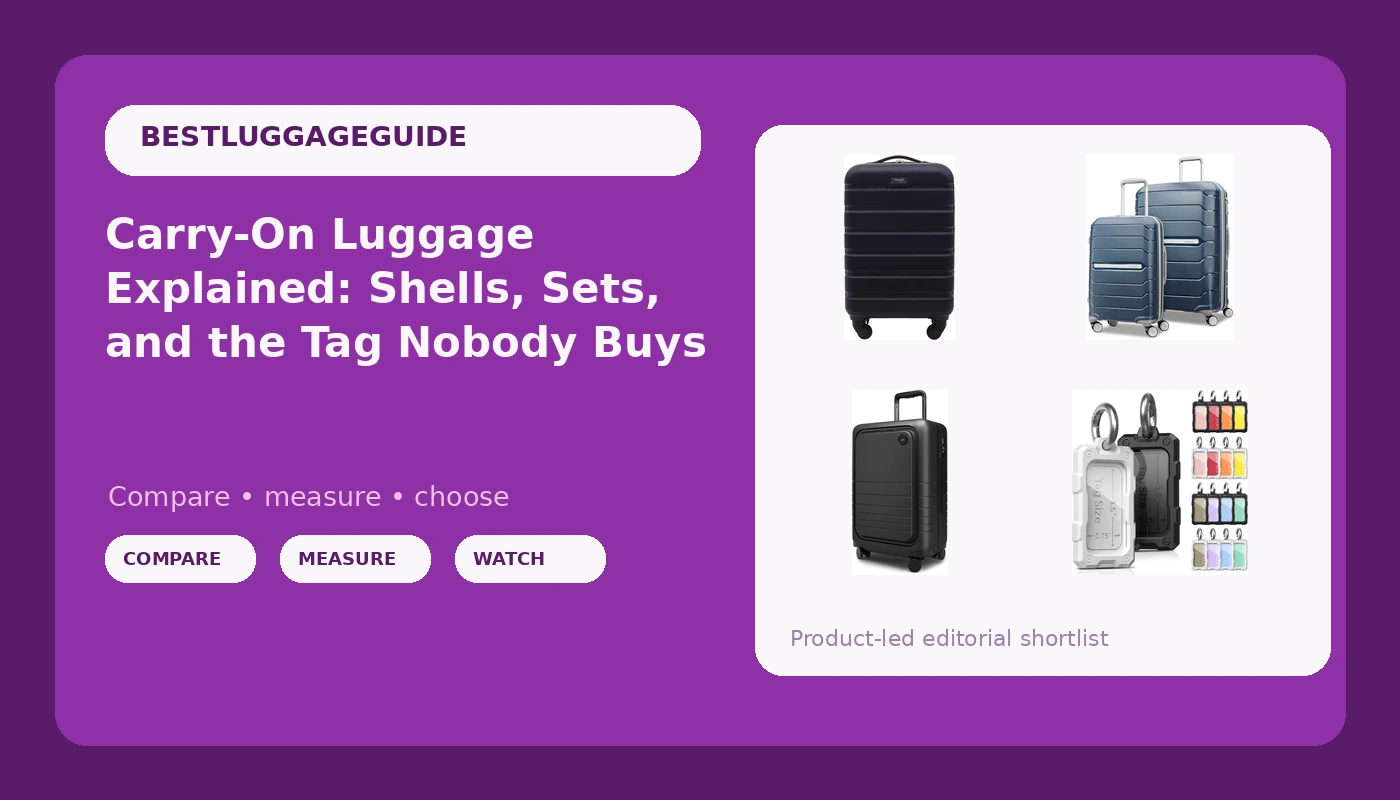
This explainer looks at four listings that solve four different problems: a budget 21.5-inch spinner, a premium 21-inch hardside, a two-piece hardshell pairing, and a 16-piece set of plastic key tags. Only three of those are bags. The fourth is the kind of small accessory that quietly fixes the most common failure in gate-checked travel, which is a bag that arrives on the carousel with nothing on it that tells anyone whose it is.
Related: How to Measure a Bag for Bin Fit →
Quick answer
Match the bag to the trips you actually take, not the trip you took once. For a first carry-on on a tight budget, the Wrangler 21.5-inch spinner is the lowest-cost way into a wheeled bag in the size class most US carriers publish. For frequent flying and a hardside shell, the Monos Carry-On Pro Plus is the premium single-bag option. For travelers who need a carry-on and a large checked bag from one purchase, the Samsonite Freeform two-piece pairing covers both roles. The key tags are a labeling accessory, not a substitute for a proper bag tag; buy them only if you have several things to label.
Four useful options
The table sorts the four listings by the job each one does. None of them is a universal answer, and the right pick depends on how you fly.
| Model | Best fit | What stands out |
|---|---|---|
| Wrangler 21.5" Spinner Carry-On Luggage, Navy Blue | A first carry-on on a tight budget | Listed at 21.5 inches with spinner wheels in a navy colorway |
| Monos Carry-On Pro Plus Luggage 21 Inch Hardside Spinner Suitcase | Midnight Black | Frequent flyers who want one hardside bag | A 21-inch hardside shell with spinner wheels in Midnight Black |
| Samsonite Freeform 2-Piece Luggage Set - Carry-On & Large Checked Luggage with Dual Spinner Wheels - Durable Polypropylene Hardshell - TSA Lock, Airline-Approved - Expandable Hard Shell - Navy | Travelers who need a carry-on and a large checked bag | Polypropylene hardshell, dual spinner wheels, TSA lock, expandable construction |
| 16 Pcs Solid Plastic Key Tags with O Rings, Custom ID Name Label | Labeling several bags, keys, or pouches | 16 plastic tags with O rings and a writable name label area |
Budget pick: Wrangler 21.5" Spinner Carry-On Luggage, Navy Blue
The trade-off at this price is information as much as materials. The listing title does not advertise a shell material, so you will want to confirm on the product page whether you are getting a soft-sided bag with exterior pockets or a rigid shell, because that single detail changes how you pack. What you are almost certainly giving up is hardware refinement: budget wheel sets are louder on tile, and budget handles are where wobble shows up first. If your travel is two or three round trips a year and you are not checking a bag, that trade can be perfectly rational. If you fly twice a month, you will feel the difference within a year.
Premium hardside: Monos Carry-On Pro Plus Luggage 21 Inch Hardside Spinner Suitcase | Midnight Black
Hardside is the category where shoppers most often pay for aesthetics and call it durability. The honest position: a polycarbonate or polypropylene shell resists crushing better than fabric, but it also transfers impact to its corners, and corners are where hardside bags fail. When you look at this listing, check the design of the exterior organization, since front-access panels change how a hardside bag actually packs. If you want one bag that looks deliberate in a hotel lobby and you fly enough to justify the spend, this is the premium single-bag route. If you want the same shell behavior at a lower price, that is what the next option is for.
Carry-on plus checked: Samsonite Freeform 2-Piece Luggage Set - Carry-On & Large Checked Luggage with Dual Spinner Wheels - Durable Polypropylene Hardshell - TSA Lock, Airline-Approved - Expandable Hard Shell - Navy
The catch with any two-bag purchase is that you may be paying for a bag you do not need yet. If you fly carry-on only, the large checked piece sits in a closet. The reverse is also worth thinking about: the carry-on and the checked bag here are built to the same design language, which makes them easy to spot together on a carousel, but it also means both share whatever the wheel and handle hardware turns out to be. Expandable construction is genuinely useful, with one caveat: expanding a carry-on pushes it toward the outer edge of published size limits, and a gate agent working a full flight is exactly the person who will notice.
Labeling add-on: 16 Pcs Solid Plastic Key Tags with O Rings, Custom ID Name Label
Here is the realistic use case. Every bag you own should carry two identifiers: one on the outside and one inside, because exterior tags get torn off by belts and sorters. A set of 16 tags lets you label the outside of several bags, the inside of each one, plus the pouches and cables that live in them, all at once. What it does not do is survive the same abuse a heavy leather or rubber bag tag does, and it will not hide your phone number from anyone standing behind you in a queue. Use them as the cheap layer of a labeling system, not the whole system.
Prices and availability may change. Product images, names, and retailer links are matched to verified listings. No current price, rating, stock status, or measured result is stated here without current evidence.
What "carry-on size" actually means
Airlines measure bags in linear inches, which is simply length plus width plus height, and they publish a maximum for the overhead bin. Most major US carriers publish a carry-on limit in the neighborhood of 22 by 14 by 9 inches, but that number is a policy, not a law, and it changes. Budget carriers and international airlines are often stricter, and some of them enforce a weight limit on the carry-on itself that has nothing to do with dimensions at all.
The practical consequence is that the number in a product title is only a starting point. A bag advertised at 21 inches may measure differently once you include the wheels, the handle, and any exterior pockets. Measure your own bag with a tape at home rather than trusting the title, and measure it the way the airline does. If you want a second check, use the bin gauge at the gate before boarding starts, which is exactly what the gate agents are using.
What fails first, and what the listing tells you
Zippers go first, then handles, then wheels. That order holds up across price points, which is why a bag with unremarkable materials and excellent hardware outlasts a prettier bag with cheap hardware every time. When you read a listing, look for whether the shell material is named, whether the wheels are described as dual or single, and whether the handle system is described at all.
Hardside versus softside is a packing question, not a style question. Rigid shells protect fragile contents and resist rain, but they have no exterior pockets and no give when a bin is tight. Soft-sided bags flex into odd spaces, carry exterior organization, and are easier to squeeze into an overhead, but they transfer impact straight to what is inside. Match the choice to what you pack: electronics and crushables favor hardside, odd-shaped gear and last-minute additions favor softside.
Here is the order I would work through it:
- Measure the bag you own now, including wheels and handles, so you know your real baseline.
- Write down your actual trip mix for the past year: how many carry-on only, how many with a checked bag.
- Decide hardside or softside based on what you pack, not on what photographs better.
- Weigh the bag's own weight against your allowance, since every pound of bag is a pound of clothing you leave home.
- Check the current size and weight rules for the airlines you fly most before you buy, not after.
Practical guidance for flying with a carry-on
- Put an identifier inside the bag as well as on the handle, because exterior tags are the first thing a belt destroys.
- Photograph the bag, the tag, and the contents before you fly, so a claim is a description rather than a memory.
- Use the key tags on the small stuff, and keep a dedicated bag tag for the bag itself.
- Do not expand a carry-on before a flight that looks full, since a full flight is when gate checking happens.
- Test the handle wobble and roll the wheels on both tile and carpet during the return window, because that is when the flaws show up and when you can still do something about them.
Which option should you choose?
Choose the Wrangler 21.5" Spinner Carry-On Luggage, Navy Blue when you want a wheeled carry-on in a common size class at the lowest cost and you fly a few times a year. Choose the Monos Carry-On Pro Plus Luggage 21 Inch Hardside Spinner Suitcase | Midnight Black when you fly often enough to care about a hardside shell and you want a single premium carry-on. Choose the Samsonite Freeform 2-Piece Luggage Set - Carry-On & Large Checked Luggage with Dual Spinner Wheels - Durable Polypropylene Hardshell - TSA Lock, Airline-Approved - Expandable Hard Shell - Navy when you genuinely need both a carry-on and a large checked bag and want them from one purchase. Choose the 16 Pcs Solid Plastic Key Tags with O Rings, Custom ID Name Label when you want to label several bags, pouches, or keys without buying individual tags.
One caveat that matters more than the comparison itself: none of these listings was tested for this article, and the guidance here comes from published product details and general construction patterns rather than from measured results. Sizing and weight rules vary by airline and change without much notice, so verify the current policy for your route before you commit to a bag.
The bottom line
Carry-on luggage is a dimensions problem first and a materials problem second. Get the size right for the airlines you actually fly, then decide how much you want to spend on the parts that fail: the zippers, the handle, and the wheels. The Wrangler spinner is the low-cost entry into the right size class. The Monos is the premium hardside answer. The Samsonite pairing makes sense if you need two bags and do not want to shop twice. And the key tags cost less than a sandwich, which is exactly why they belong in the cart if you have ever stood at a carousel wondering whether that black bag was yours.