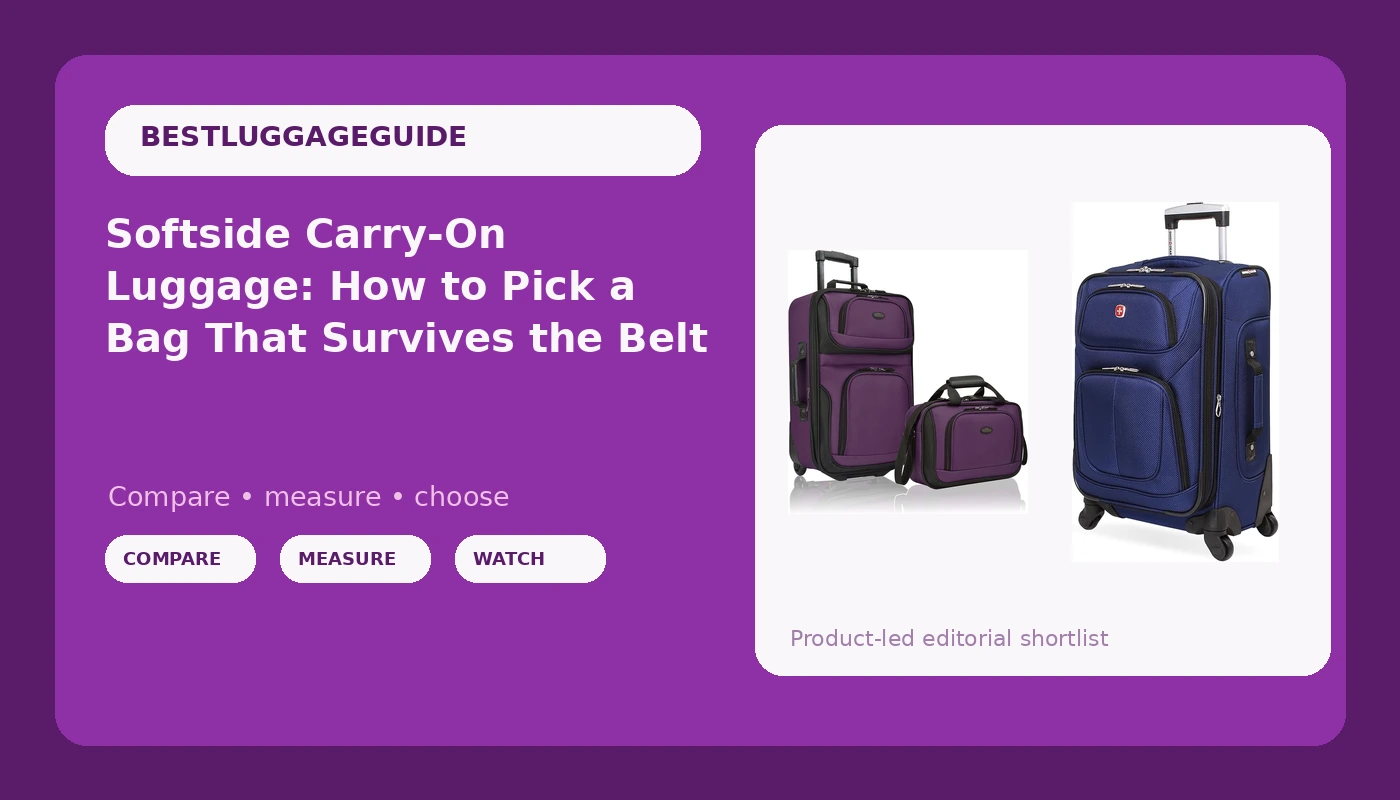
Softside carry-on luggage is the unglamorous answer to a question the airlines keep making harder. Walk through any terminal and you will see the hard shells in their social-media colors, and then you will see the soft bags that have been on two hundred flights and still close.
I spent six years as a gate agent at O'Hare, which means I spent six years watching what happens to bags after you hand them over. Then I spent four more years flying more than 120 segments a year and reviewing luggage full time. Softside keeps winning the practical argument for one reason: fabric gives. A hard shell either fits the sizer or it does not. A soft bag, packed with a little discipline, will compress into the bin that the shell next to it just failed.
This is not a brand popularity contest. It is a walkthrough of how to choose a softside carry-on, how to pack it so it passes the sizer without drama, and how to fly it without paying a gate check fee you did not plan for.
Why you should trust me
I worked the gate at O'Hare before I ever wrote a review. That job teaches you what a bag actually goes through: thrown down a belt, stacked four high in a cart, dropped onto a tarmac in February, and pulled by a handle that was never designed for that abuse. Now I judge every case the way I did at the gate. What survives the belt. What fits the bin. What the airline will not fight you about.
I fly carry-on only on almost every trip, and I keep a rotating stable of cases so I can compare them against each other instead of against a memory. I also keep a tape measure in my bag and a kitchen scale at home, because the numbers on a product page and the numbers on a real bag are frequently two different things.
One thing I will not do here: pretend I have personally flown the two bags below for years. I have not. What I can tell you is exactly what their specs say, what those specs mean at a gate, and what to check the day the box arrives so you find out before the airport does.
How I picked and how I tested
Every carry-on I look at gets the same treatment, and you can run the same checklist at home.
First, linear inches. Add length plus width plus depth. That total, not the diagonal, is what your airline's sizer is checking. A bag advertised as a 22-inch carry-on often measures 23 or 24 once you include the wheels and the handle, because the marketing number is the body only.
Second, wheelbase. A two-wheel bag has a fixed axle at the back and rolls on a tilt. A four-wheel spinner rolls upright and turns on a dime, which is lovely on tile and a liability on carpet and jet bridges with a lip. Wider wheel spacing tracks straighter. Narrow spacing wanders and clips the seat legs.
Third, handle wobble. Grab the extended handle and rock it side to side. If it moves more than a quarter inch before the bag moves, that is the part that will fail first.
Fourth, zipper hardware. Zippers die before shells do. Look for metal pulls and a liner that is stitched down flat so the slider cannot catch it at 3am in a hotel room.
Fifth, empty weight. On a 50-pound checked allowance, every pound of case is a pound of your stuff you cannot bring. On a carry-on you are mostly fighting your own shoulder, but weight still matters when the bag is on your back on a jet bridge.
I compare bags on those five things, then I look at how they are likely to behave in a full bin on a full flight, which is the only test that really matters.
The softside carry-ons in this guide
Two bags, two very different answers to the same question. One is a budget two-wheeler. One is a mid-tier expandable spinner. Both are softside, which is the point.
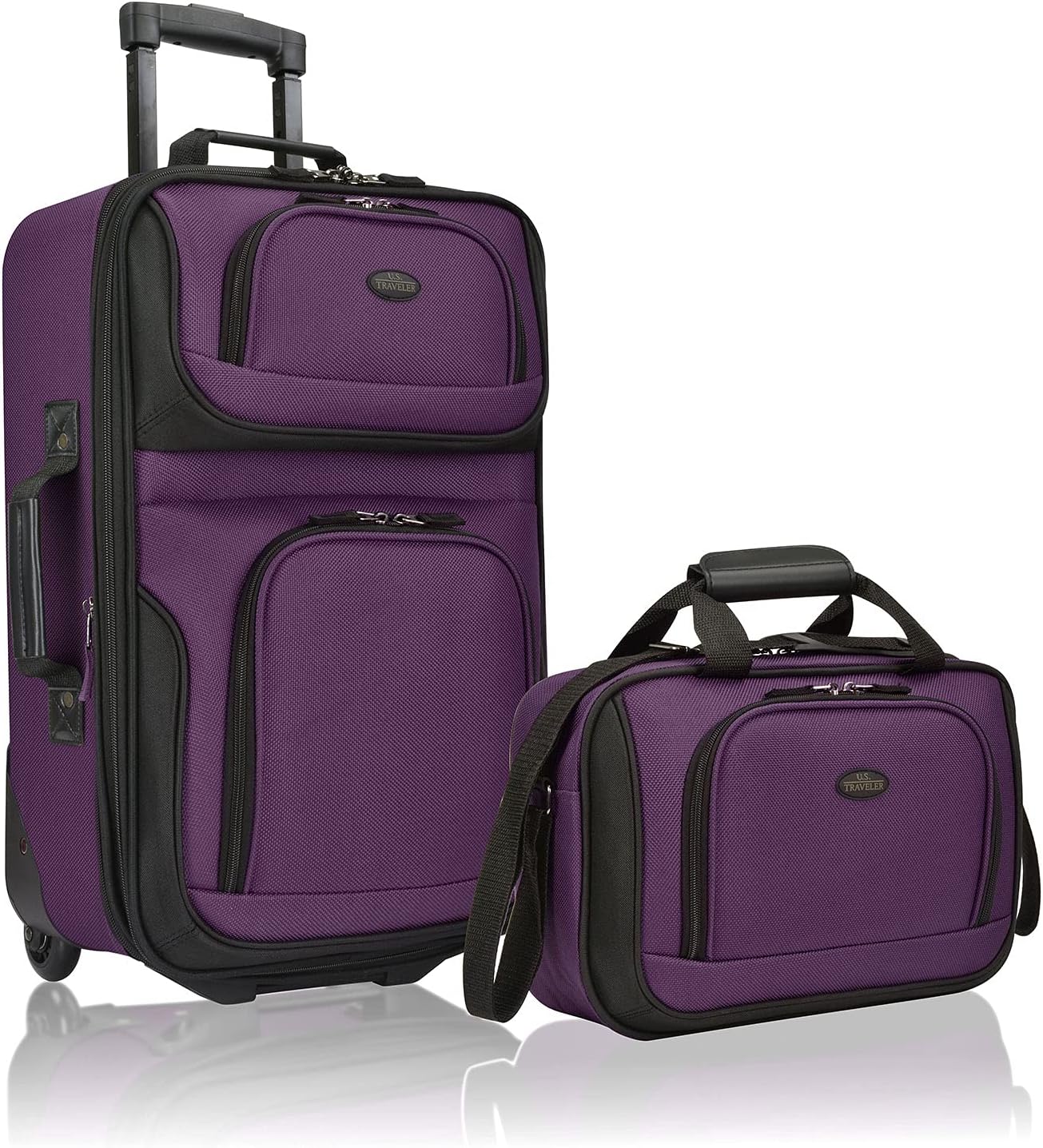
Budget pick: U.S. Traveler Rio Lightweight Softside Rolling Carry-on Suitcase, 2-Wheel Set, Purple
 Visit on Amazon →
This is the bag I point people toward when the budget is tight and the priority is a carry-on that does the job without a lot of ceremony. It is a softside roller with a two-wheel set, which means a fixed axle at the back and a tilt-and-drag roll. At the gate, that configuration is not a downgrade. Two-wheel bags have a lower, wider stance, they track straighter on carpet, and they sit flatter in an overhead bin because there is no spinner hardware sticking out on all four corners.
The purple colorway is a real advantage, by the way. Every bag on a carousel is black. A bag nobody else owns is a bag you spot in ten seconds.
What to check when it arrives: put it on a kitchen scale empty, then measure it with a tape from the top of the extended handle to the bottom of the wheels. Those are the two numbers that decide whether you sail past the sizer or get pulled aside.
Flaws but not dealbreakers: Two wheels mean you carry more of the weight on your arm than a spinner does, and the tilt gets tiring on a long terminal walk. Fabric also scuffs and shows dirt faster than a shell. Neither is a reason to skip it at this tier.
This is for the traveler who wants a light, simple softside carry-on, flies a handful of times a year, and would rather spend the difference on the trip.
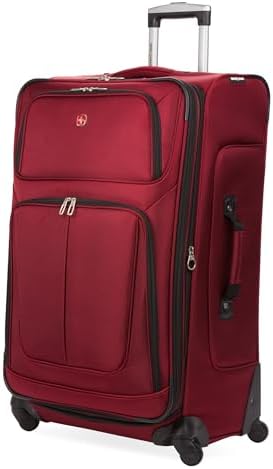
Our pick for expandable packing: SWISSGEAR Sion Carry-On Spinner Luggage, Softside Expandable, Lightweight Suitcase, Blue, 22.75-Inch
 Visit on Amazon →
This one is the more capable bag of the two. It is a softside spinner with an expandable main compartment, listed at 22.75 inches, in blue. The spinner wheels make it easy to push upright through a crowded concourse with a coffee in the other hand, and the expandable zipper gives you a couple of inches of depth when you are coming home with more than you left with.
That expansion is also the trap, and I want to be blunt about it. An expanded softside bag is a bigger bag. On a full flight, a bigger bag is the first one the gate agent looks at, and if it does not slide into the sizer, it rides in the hold. Use the expansion for the trip home if you must, and know that you are gambling on bin space when you do.
The 22.75-inch number deserves your attention too. That is right at the edge of what most US carriers accept as a carry-on, and depending on how the bag is measured, wheels and handle included, it can land over the line. Measure it yourself before your first flight, and check your airline's current published limit rather than a blog post from 2019.
What to check when it arrives: spin it loaded on tile and on carpet and listen. Rattling wheels are a shopping cart, not a suitcase. Then rock the extended handle and feel for wobble.
Flaws but not dealbreakers: The expandable section adds weight and bulk even when it is zipped shut, and spinner wheels eat bin space at the corners. If your home airport has narrow bins, the two-wheeler above fits more easily.
This is for the traveler who wants one softside bag that can do a four-day trip and a long weekend, and who values rolling it upright over dragging it on a tilt.
The actual workflow: flying carry-on only with a softside bag
Now the part you came for. This works with either bag above and with any softside carry-on you already own.
Step one: Measure it yourself. Tape measure, empty bag, handle extended. Length plus width plus depth, in inches. Write the number on a sticky note. If it is over your airline's published carry-on limit, you have two choices: fly an airline with a bigger allowance, or accept that this bag is a checked bag.
Step two: Weigh it empty. Kitchen scale, bag only. A softside carry-on that weighs eight or nine pounds empty has already spent a fifth of a typical checked allowance before you pack a single shirt. If your number is high, the fix is a lighter bag, not a lighter wardrobe.
Step three: Learn the sizer before you need it. Every gate has a metal frame, and it is the only opinion that counts. On a slow afternoon, drop your empty bag in it. You will learn in five seconds whether the wheels or the handle push you over, and you will never be surprised at boarding again.
Step four: Pack in layers, not in piles. Soft bags reward structure. Rolled clothing along the bottom, flat items on top, heavy items centered over the wheelbase so the bag does not tip when it stands. Packing cubes are the single best under-fifty-dollar travel purchase you can make. They do not save space so much as they save your sanity at 3am in a hotel room.
Step five: Leave the expansion zipper alone until the trip home. The expansion is a return-trip feature. Opening it on the way out means you are already over the sizer on day one, with a full trip of souvenirs still ahead of you.
Step six: Keep the weight over the wheelbase. The further your heavy items sit from the wheels, the more the bag wants to fall forward when it stands. Center the load, and the bag stands up on its own in the bin.
Step seven: Test the handle before you leave the house. Extend it fully, rock it side to side, push it back down. Handle wobble is the second most common failure after zippers, and it announces itself early. If it wobbles new, it will wobble worse at gate 14.
Step eight: Know the gate check rules before you board. Boarding order, cabin size, and whether your fare even includes a carry-on all vary by airline and change often. Look up the current policy for your specific airline and fare before you fly, not the one you remember from last summer. If you get gate checked, pull the battery packs, the medication, and anything you cannot live without for 24 hours. They go in your personal item.
Do those eight things and a softside bag will beat a hard shell more often than not, because it can compress into space that a shell has to refuse.
The competition and why it lost
Hard shells are not the enemy. Polycarbonate protects fragile contents better than fabric, it shrugs off rain, and it looks sharper in a photo. What it does not do is compress. A shell either fits the bin or it does not, and on a full flight that difference is the whole ballgame. I have also watched enough shells come off a belt with a cracked corner to stop treating the material as a durability guarantee. The shell protects your stuff. It does not necessarily protect itself.
Four-wheel spinners are the other argument, and this one is closer. Spinners are easier on tile, easier in a crowded concourse, and easier on your shoulder. Two-wheel bags are better on carpet, better on jet bridge lips, and better in a tight bin. Neither is wrong. Pick based on the airports you actually use.
The thing that genuinely loses is the set. A three-piece set forces you to buy a large checked bag you did not ask for, at a quality level that is usually lower than buying one good carry-on on its own. Buy the size you actually need. Oversized bags get checked, and checked bags get lost.
What this all costs
The two bags in this guide sit in different tiers, and the honest math is about cost per trip, not sticker price.
- A budget softside two-wheeler is the entry point. Check current Amazon price for the current number.
- A softside spinner with an expansion zip costs more, and buys you easier rolling and a few more inches of depth.
- Packing cubes: under fifty dollars, and they will outlast two bags.
- A kitchen scale and a tape measure: you probably own both, and together they are the cheapest insurance against a gate check fee.
Over five years and twenty trips, the difference between the budget pick and the upgrade pick works out to a few dollars a trip. The thing that actually costs you money is buying the wrong size, expanding it at the gate, and paying to check a bag you swore you would carry on.
Measure the bag. Weigh it empty. Pack it in layers. Test the handle before you leave the house.
That is the job. Softside has been doing it for decades.