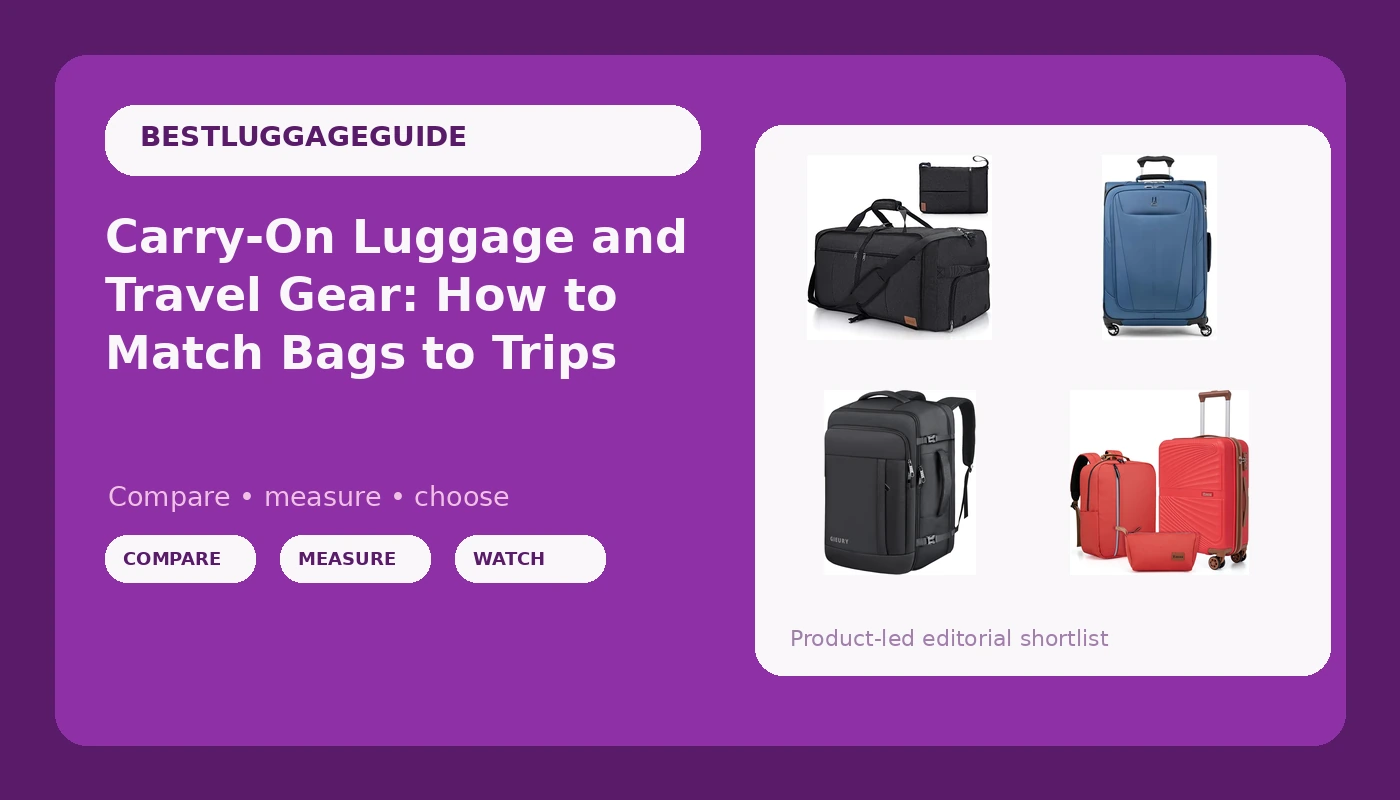
Four bags, four jobs, and one question underneath all of it: what will the airline actually let you bring on board? This guide walks through carry-on luggage and travel gear the way it gets used at the airport, not the way it gets photographed in a studio. There is a softside spinner sized for checked trips, a TSA-friendly backpack built for carry-on-only flying, a foldable duffel for capacity you only sometimes need, and a matched three-piece setup for long itineraries. The point is not to sell you all four. It is to help you figure out which one covers the flying you actually do, and which details decide whether a bag is still rolling in year two.
Related: How to Measure a Carry-On Against Real Airline Bin Sizes →
Quick answer
Match the bag to the trip, not to the photo. For carry-on-only flying, a TSA-approved backpack or a 20-inch case keeps you out of the gate-check argument. For checked travel, a softside spinner in the 25-inch class gives you the most usable packing room for the weight you are allowed. For capacity that only appears when you need it, a foldable duffel is the cheapest insurance you can pack. A matched multi-piece setup makes sense mainly for travelers who check bags on longer trips and want the pieces to nest and look consistent. The distinctions below come from the product listings and how each bag is built, not from a controlled lab test.
4 useful options
| Model | Best fit | What stands out |
|---|---|---|
| Travelpro Maxlite 5 Softside Checked Luggage Spinner, Blue, 25-Inch | Checked travel where softside flex matters | Softside construction in a 25-inch checked spinner size |
| Carry On Backpack TSA Flight Approved, Large Travel Backpack for Men Women | Carry-on-only trips | Listed as a TSA flight approved carry-on backpack |
| 120L Foldable Collapsible Waterproof Travel Duffel Bag for Men and Women | Overflow and one-way capacity | 120-liter capacity that folds down when empty |
| Eeeza Carry On Luggage Set Suitcase 3 Piece,Red (20"/BP/TB) | Travelers who want matching, nesting pieces | Three-piece setup built around a 20-inch case |
The known quantity: Travelpro Maxlite 5 Softside Checked Luggage Spinner, Blue, 25-Inch
The argument for softside at checked size is not aesthetic. A fabric body absorbs contact instead of transferring it, and it tends to be lighter than a comparable hard shell, which matters because every pound of case is a pound you cannot pack. The argument against it is water resistance and structure: softside bags can compress awkwardly and offer less protection for fragile contents. If you check a bag more than twice a year and your priority is usable capacity per pound, this is the category to start in.
The carry-on workhorse: Carry On Backpack TSA Flight Approved, Large Travel Backpack for Men Women
Backpacks solve a specific problem: they fit into spaces that rolling cases cannot, and they leave both hands free in a jet bridge. They create a different problem, which is your shoulders. Load a large travel backpack to its practical limit and you will feel it by the second connection, so pack it with that in mind rather than filling every cubic inch just because the space exists. The other trade is structure. A soft backpack does not protect fragile items, and it does not stand up on its own in a hotel room.
The overflow bag: 120L Foldable Collapsible Waterproof Travel Duffel Bag for Men and Women
A bag this size changes the math on checked baggage. Fill 120 liters with clothing and dense items and you can walk right up to, or past, a standard 50-pound checked limit, so weigh it before you leave the house rather than at the ticket counter with a line behind you. Where a duffel like this earns its place is on trips with an uneven packing profile: light on the way out, heavy on the way back, or a one-way move where you need volume more than structure.
The matched setup: Eeeza Carry On Luggage Set Suitcase 3 Piece,Red (20"/BP/TB)
Here is the honest caveat about sets: you pay for pieces whether or not you use them. If you fly a mix of two-day work trips and week-long vacations, a set can genuinely cover both. If you fly one kind of trip, you are buying two bags to store. The 20-inch case in this set is the piece that fits carry-on rules; the backpack and tote are useful as personal items and day bags, but they are not overhead-bin solutions on their own.
Prices and availability may change. Product images, names, and retailer links are matched to verified listings. No current price, rating, stock status, or measured result is stated here without current evidence.
How linear inches and bin fit actually work
Linear inches are just length plus width plus height, and that single number is what most airline size rules are written around. The commonly cited carry-on figure sits in the neighborhood of 22 by 14 by 9 inches, but published limits are not identical across carriers, they differ by fare class and aircraft, and they change. Check your airline's current page before you buy anything, because the rule you are packing against is the one that applies on your travel date, not the one in a blog post from three years ago.
The other half of bin fit is that the published limit and the actual overhead bin are two different things. On some aircraft the bin is generous; on others a legal bag still has to go in at an angle or gets flagged at the gate. A backpack generally negotiates this better than a rigid case because it can compress. A rolling case with a solid frame has to fit exactly, and if it does not, you are checking it.
There is also the measurement problem. Cases are sometimes marketed by a number that does not match what you get when you put a tape measure on the bag with wheels and handle included. When a case is listed at one size and measures larger in your hallway, the gate sizer does not care about the marketing. Measure before you commit.
Softside, hardside, and the weight math
Every case has a weight, and that weight comes out of your allowance. If your airline gives you 50 pounds and your case weighs 9, you are packing 41 pounds of actual life. Softside bags generally weigh less than hard shells of the same size, which is the quiet advantage nobody puts in the ad copy.
Hard shells win on water resistance and on the visual argument. They lose on corner damage: polycarbonate can crack when it lands wrong, and it lands wrong regularly. Softside absorbs that contact. The failure points are different too. On a softside bag, the zipper and the handle are what die first, usually in that order, and a zipper that catches the liner or a handle that wobbles before the first flight tells you what year three looks like.
How to choose, step by step
- Count the trip before you count the bags: days, laundry access, climate, and whether you will shop at the destination.
- Decide honestly whether you are a carry-on-only traveler or a checked-bag traveler. Most people are the second one on long trips and the first one on short ones.
- Look up your airline's current published carry-on and checked size and weight limits for your fare class, and write the numbers down.
- Compare the empty weight listed for each bag against your allowance. A lighter case leaves more room for what you actually need to bring.
- Buy the fewest pieces that cover your real trips, not the most pieces the listing offers.
Practical guidance for these bags
- Use packing cubes inside the softside spinner and the backpack. They do not create space, but they keep a 25-inch case from turning into a loose pile at 3am in a hotel room.
- Weigh a checked bag at home before you leave. A bathroom scale and a five-second lift will save you a repack at the counter.
- Keep the foldable duffel empty on the outbound leg and treat it as return-trip capacity, not as a second checked bag you pay for twice.
- If you buy the three-piece setup, decide in advance which pieces earn their space. A tote that never leaves the closet is money you spent on a color match.
- Test bin fit early rather than at the gate. Boarding with your bag already compressed and oriented saves you the gate-check conversation entirely.
Which option should you choose?
Choose the Travelpro Maxlite 5 Softside Checked Luggage Spinner, Blue, 25-Inch when you check a bag on most trips and want softside flexibility and a lighter body working in your favor. Choose the Carry On Backpack TSA Flight Approved, Large Travel Backpack for Men Women when you fly carry-on only and want a bag that compresses into whatever bin you get. Choose the 120L Foldable Collapsible Waterproof Travel Duffel Bag for Men and Women when your packing volume is unpredictable, or when you need a one-way bag that folds away when it is empty. Choose the Eeeza Carry On Luggage Set Suitcase 3 Piece,Red (20"/BP/TB) when you genuinely fly several trip lengths a year and want one purchase that covers all of them.
One caveat on all four: these are listing-level descriptions, not results from a long-term durability test, and no bag survives forever. Zippers, handles, and wheels are the parts that fail, on every brand, and how a specific unit holds up depends on how it is packed and how it is handled.
The bottom line
The right carry-on luggage and travel gear is the smallest set of bags that covers the trips you actually take. If you fly short and often, a TSA-approved backpack or a 20-inch case is the whole answer. If you check bags, a softside spinner in the 25-inch class gives you the most capacity per pound of case weight, and the Travelpro Maxlite 5 is the well-known version of that formula. Keep a foldable duffel folded in the bottom of whichever bag you choose, buy a matched set only if you will use the pieces, and check your airline's current size and weight rules before every trip where they matter.