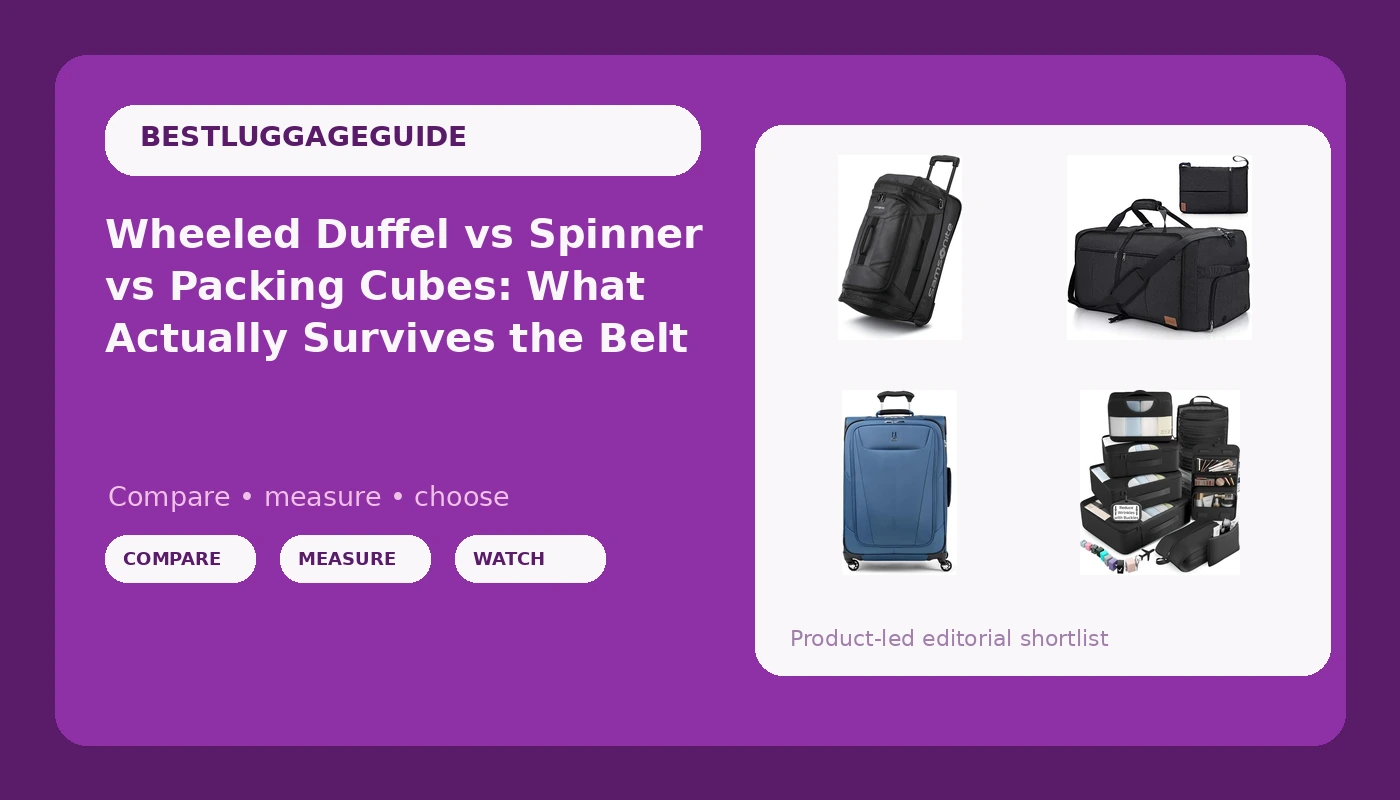
I spent six years as a gate agent at O'Hare, which means I spent six years watching other people's bags get thrown onto carts, stacked four high, and sent back up a chute with a wheel missing. I've flown more than 120 segments a year for the last four years, and I still judge every bag the way I did at the gate. So when I sit down to write a softside spinner vs wheeled duffel comparison, I don't start with colorways or Instagram photos. I start with what happens between the ticket counter and the carousel.
The four items here are not four versions of the same thing, and that is the whole point. You have a wheeled duffel built around gear that refuses to be rectangular, a 120L collapsible duffel that lives folded in a closet until you need it, a softside spinner that does the day-to-day work, and a packing cube set that keeps the inside of either bag from turning into a laundry pile by day two.
Related: Softside vs Hardside Luggage: What Survives the Baggage Belt
The best setup for most travelers in 2026 is a softside spinner as the main bag, a collapsible duffel as overflow, and packing cubes inside both. The wheeled duffel is the specialist pick for boots, helmets, camera cases, and anything that will not fold flat.
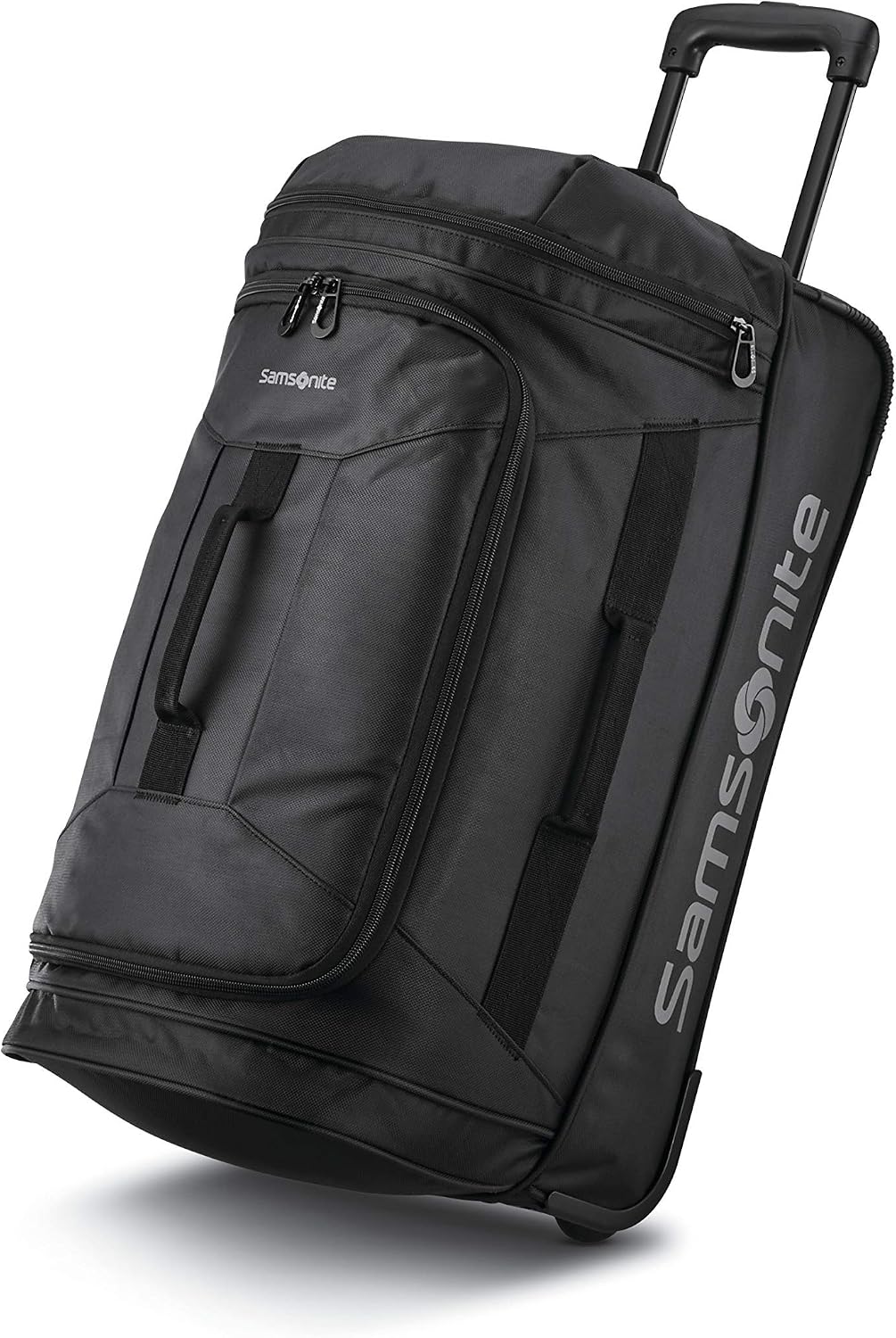
Samsonite Andante 2 Wheeled Duffel Bag, 22-Inch
Wide duffel mouth swallows boots, helmets, and odd shapes, and inline skate wheels roll over tile joints and curb lips
Two wheels mean all the weight sits on one wrist, and it will not track beside you like a spinner
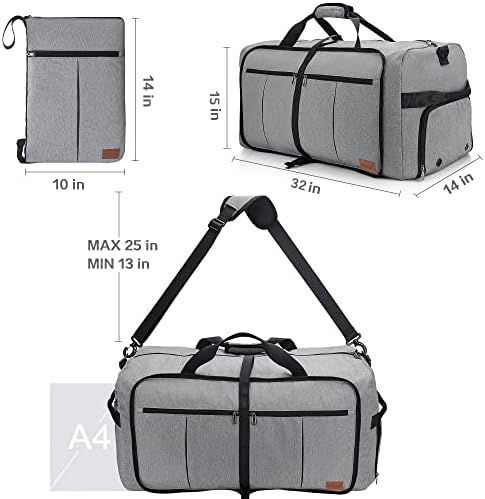
120L Foldable Collapsible Waterproof Travel Duffel Bag
Folds flat when empty, wipes clean, and holds a genuinely enormous amount of stuff
120 liters is checked-bag territory, and a full soft duffel is a miserable carry through a terminal
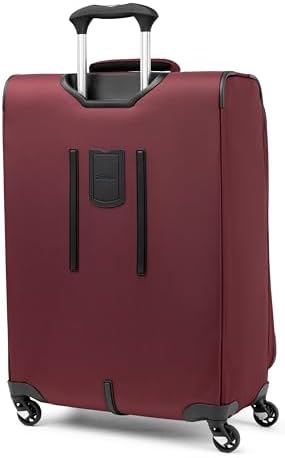
Travelpro Maxlite 5 Softside Checked Luggage Spinner, Blue, 25-Inch
The softside case airline crews actually roll, with four spinner wheels that track straight
25 inches means it gets checked on most carriers, so it rides the belt you were trying to avoid

Veken Packing Cubes Set with Shoe and Toiletry Bags
The cheapest way to make any bag in this list behave, and the set covers shoes and toiletries too
Cubes add weight and bulk, and cheap cube zippers are the first thing to give out if you overstuff them
Prices and availability were captured from Amazon Creators API and may change.
How I judge travel gear from the ramp
I run four checks on anything that comes through my hands, and I run them in this order.
First, handle wobble. I extend the handle, plant the bag, and shake it side to side. If there is movement before the bag has ever been on a plane, there will be more after twenty flights. The handle is the second thing to die on a bag, right after the zipper, and a wobbly handle makes a loaded case feel twice as heavy as it is.
Second, zippers. I look at the teeth, the slider, and whether the liner catches. A zipper that snags on the fabric will fail on a cold jet bridge in February, and it will fail in the worst possible place. On a softside case, the zipper is the frame.
Third, bin fit and linear inches. A bag advertised at 21 inches that measures 23 is a bag you will be gate checking. Sizes also mean different things on a mainline jet and a regional jet, and enforcement varies by carrier and by crew, so always check your airline's current published limits before you buy around a number.
Fourth, wheelbase. I roll a bag on tile, on carpet, and over a door threshold. Wheels that rattle like a shopping cart on tile are wheels that will annoy you for the entire trip.
Samsonite Andante 2 Wheeled Duffel: the bag for gear that is not rectangular
This is the odd-shape specialist in the group. It is a 22-inch wheeled duffel with a push-button handle and inline skate wheels, and the duffel opening is the reason to buy it. A top-loading case forces your gear into a rectangle. A duffel mouth lets you drop in ski boots, a helmet, a folding tripod, a pair of hiking boots still dirty from the trail, or a stack of gifts that will not cooperate.
The inline skate wheels are worth understanding. They are bigger and more exposed than typical spinner casters, which is why they handle tile joints, carpet edges, and curb lips so well. The trade-off is geometry: with two wheels, you tilt the bag and pull it behind you, and the weight lives on one wrist. You also cannot push it beside you down a narrow aisle.
Two other honest notes. A soft duffel has no structural frame, so packed light it slumps and packed heavy it bulges, which is exactly the profile that gets flagged at the gate. And because it is soft, it offers no crush protection for anything fragile in the middle. If your trip is mostly clothes, a duffel is the wrong shape. If your trip is mostly gear, it is the right one.
The 120L collapsible duffel: the bag that earns its space by disappearing
The 120L foldable duffel is not a bag you carry every trip. It is a bag you own so that the trip where you need it is not a crisis. It folds down to almost nothing, so it lives in a closet or a car trunk until the moment you need a checked bag for the return leg, the laundry, or the souvenirs you did not plan for.
The capacity number is real, and so is the consequence. 120 liters is well past carry-on limits on any US carrier I know of, so plan on checking it, and check your airline's current rules rather than trusting a blog. The listing describes it as waterproof, which in practice usually means a coated, water-resistant fabric rather than a true dry bag, so treat it as protection against a wet tarmac, not against a river.
The honest trade-off is carry comfort. There are no wheels and no frame here, so 120 liters of anything rides on your shoulder. A fully loaded one is a genuinely unpleasant walk from the far end of a concourse, which is why I would use it as the overflow bag rather than the primary one. It also makes an excellent dirty-laundry bag on the way home, which is a job a spinner cannot do without making your clean clothes smell like a gym.
Travelpro Maxlite 5 Softside Spinner: the bag the crew actually rolls
Travelpro is the airline crew favorite for a reason, and the Maxlite line is the best value in softside luggage, full stop. This one is the 25-inch checked spinner in blue, which means it is the bag for trips where you are not pretending to travel carry-on only.
Four spinner wheels change how you move through an airport. A spinner tracks beside you with a fingertip, which matters when you are also holding a coffee and a boarding pass. A softside shell flexes into an overhead bin, a car trunk, or a rental shuttle rack in a way a hard shell cannot, and soft panels absorb impact by deforming instead of cracking. When something does break, softside cases are also far more repairable, which matters more than most buyers realize on day one and less than they realize on year five.
The trade-offs are real. At 25 inches this is a checked bag on most carriers, so it rides the belt, and the belt is the thing I spent six years watching ruin bags. Four wheels add a little height and a lot of casters, and casters are the most fragile part of any spinner. On deep hotel carpet, you will push it. And softside gives you zero crush protection, so anything breakable goes in the middle wrapped in clothes.
Veken packing cubes: the cheapest upgrade in this list
Packing cubes are the single best travel purchase under $50, and I will argue that with anyone. They do not save space by magic. What they do is force you to fold flat and stack, which uses the volume of a bag more efficiently, and then they let you find your black t-shirt at 3 a.m. in a hotel room without unpacking the entire bag onto the floor.
This Veken set is the practical version of that idea. It comes with multiple cube sizes plus a shoe bag and a toiletry bag, which covers the two categories that most often leak, smell, or wander. In a softside spinner, cubes also keep the contents from shifting, which keeps the bag balanced and keeps the handle from feeling like it is fighting you.
The honest downsides: cubes add a few ounces and a bit of bulk, and a badly packed cube wastes more space than it saves. The zippers on any budget cube set are the weak point, so do not overstuff them and do not sit on the bag to close it. Also, cubes are not a substitute for a bag that fits your trip. They organize whatever you already own.
The trade-offs the listings never mention
Wheel count is the biggest one. Two inline skate wheels are more durable over rough ground and far better on curbs and gravel, but they put the load on one wrist and refuse to stand up on their own. Four spinner wheels track beautifully on terminal tile and are the first thing to break on a rough belt. Neither is better. They are different jobs.
Softside versus hardside is the second. Hardside wins the visual argument and protects against crush. Softside wins the practical argument by flexing into tight bins and absorbing impact instead of cracking at the corners. I have watched a thousand bags come down the belt, and corner damage on hard shells is not rare. The right choice depends on what you pack, not on what the ad photograph suggests.
Capacity is the third. A 120L bag sounds like freedom until you carry it. Oversized bags get checked more often, and checked bags get lost more often. Buy the size you actually need, not the size you are tempted by.
The last one is policy drift. Carry-on dimensions, weight limits, and enforcement change, and they change by carrier and by route. Check the current rules before you buy around a measurement, and measure the bag yourself when it arrives. A tape measure has saved me more money than any review.
Which one should you buy?
If you fly mainline jets and pack clothes, buy the softside spinner. It is the bag that will do the most trips with the fewest complaints, and the Maxlite line is where I would put my own money in that category.
If your travel involves gear that is not rectangular, if you are hauling boots or equipment, or if you want a rolling bag that survives curbs and gravel without asking for much, the wheeled duffel is the pick. Pair it with packing cubes and it becomes far more organized than its shape suggests.
If you take basecamp trips, road trips, or moves, or you simply want a checked overflow bag that disappears into a closet between trips, the collapsible 120L duffel is the one to own. Just plan on carrying it, not rolling it.
And whatever you buy, buy the packing cubes. They are the cheapest part of this list and the part that changes the most days of your trip.
What I am watching next
Airlines keep tightening carry-on enforcement, which is going to push more travelers back toward softside bags that squeeze into a bin and toward checked bags that can take a beating. I also expect direct-to-consumer brands to keep pushing polycarbonate shells under $150, and I am watching for the first brand that actually fixes zipper reliability instead of marketing around it. That brand gets the frequent flyers.
If you buy through the links on this page, I earn a small commission. It does not change what I recommend or how I rank these four.