Most travelers pack by feel and find out at the gate whether their bag clears the sizer. Carry-on bin fit is not luck and it is not a brand preference. It is arithmetic: linear inches, a scale, and a bag that measures what the tag says it measures.
I spent six years as a gate agent at O'Hare, watching bags get thrown, stacked, crushed, and occasionally lost. Now I review bags full time. The standards I use are the same ones I used behind the counter: what fits the bin, what survives the belt, and what the airline will not fight you about.
This is the order of operations. Measure first, pack second, and know exactly what to do when the gate agent says the flight is full.
Why you should trust me
Six years on the ramp side of the counter taught me one thing that no product page will tell you: the sizer is the only opinion that counts. I have watched a $600 case get gate checked and a $60 case walk onto the plane, and the difference was four ounces and half an inch of shell.
I do not publish numbers I have not measured, and I do not repeat airline policy without checking the current rules first. What I can give you is the process the airline uses on you, translated into something you can do at home in ten minutes. Where something below is my opinion rather than a rule, I say so.
What "fits the bin" actually means
Linear inches are length plus width plus height, and every domestic carrier publishes its cabin limit in exactly those terms. The number most US airlines settle on is 22 by 14 by 9. That is a common number, not a universal one, and your airline's current published limit is the only one that matters. Check it before you fly.
Two details trip people up. First, wheels and handles count. A case sold as 22 inches that measures 24 with the wheels and the extended handle is a 24-inch bag at the sizer. Second, the sizer at the gate is the final word. It is a metal frame. It does not negotiate, and it does not care what the product page claimed.
Weight is the other half of the contract. Every ounce of case weight is stolen from your allowance before you pack a single item, and some international carriers cap cabin bags at 7 kilograms and weigh them at the gate. A case that is light empty is worth more than a case with a prettier shell.
Then there is the split that decides most of these arguments. Softside squishes. Hardside does not. A softside bag that is a quarter inch over can compress into a sizer. A hardside shell that is a quarter inch over is a quarter inch over, every time.
Two bags that cover both jobs
One of these is built for the bin and one of them is built for the belt. That is deliberate. Most people need both jobs handled, and the mistake is trying to make one bag do work it was not designed for.
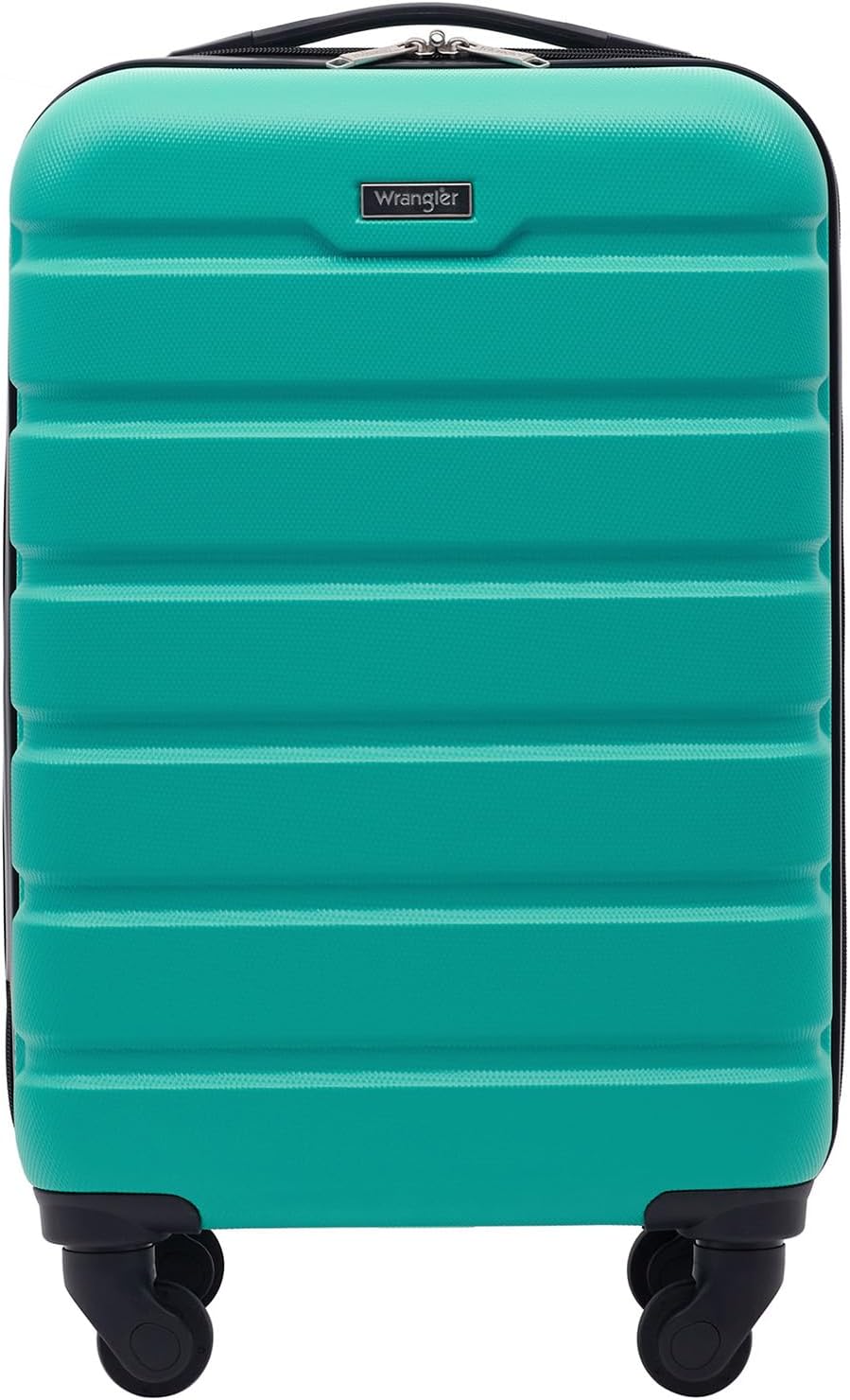
Carry-on pick: Wrangler 22" Hardside Spinner Carry-On Luggage, Teal
 Visit on Amazon →
This is the bag for the traveler who wants to walk on with everything they own for a three-day trip. It sits in the 22-inch class, which is the size class the domestic sizers are built around, and the four spinner wheels let you push it beside you instead of dragging it behind you, which matters more than people admit when you are crossing a terminal at a jog.
The hardside shell does two things well. It wipes clean, and it protects anything crushable, which is why it is the right call for camera gear or a bottle of something you would rather not have explode in a duffel. The teal is also genuinely useful: a color that does not look like every other black rectangle on the belt is easier to spot if you end up gate checking it.
Flaws but not dealbreakers: A hardside shell has zero give. If you are the type who buys one souvenir too many and needs the bag to stretch, this is not the bag for that. Verify the published dimensions include the wheels and the handle before you commit, because a 22-inch class case that measures 23 at the sizer is a problem you cannot solve at the airport.
Check current Amazon price before you decide. Anyone who flies carry-on only and wants a shell that shrugs off the overhead bin will get the most out of this one.
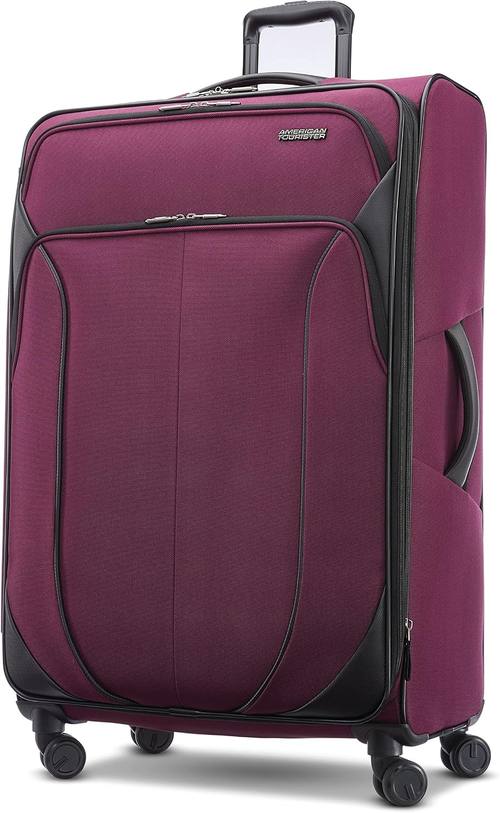
Checked pick: American Tourister 4 KIX 2.0 Expandable Softside Luggage with Spinner Wheels, 28 SPINNER, PURPLE ORCHID
 Visit on Amazon →
A 28-inch spinner is a checked bag. It is not a carry-on, and it should not be treated like one. That is the entire point of including it here: once you accept that you are checking a bag, softside wins the practical argument.
Softside gives you exterior pockets you can reach without opening the whole bag, fabric that flexes around odd shapes, and an expansion zipper for the return leg when you have bought more than you planned. The 28-inch class is the one that holds a week of clothes for two people without a second bag, and the purple orchid color is not subtle, which is exactly what you want when you are standing at a carousel at 11pm trying to spot your bag from thirty feet away.
Flaws but not dealbreakers: Zippers are the first thing to die on a softside bag, and the expansion zipper is the weakest one on the case. Expansion is also not free: it pushes you toward the airline's size and weight limits and it moves the load away from the wheelbase, which makes the bag more likely to tip when you are pulling it through a crowded terminal. Leave the expansion closed until you are actually at your destination.
Check current Amazon price. Anyone who checks a bag on every trip and wants pockets, flex, and room to bring things home will be happy here.
The packing workflow that keeps you under the limit
Now the part you came for. This works with any bag, hardside or softside, and it takes about ten minutes at home.
Step one: measure the empty bag. Tape measure, all three dimensions, wheels and handles included. Write the numbers on a sticky note and leave it in the bag. If the total is over your airline's published limit, you have a decision to make before you pack, not at the gate.
Step two: weigh the empty bag. A bathroom scale is accurate enough. Subtract that number from your airline's weight limit and you know exactly how many pounds of stuff you get. Most people have never done this and it is the single most useful number in this article.
Step three: pack heavy items at the wheel end. Put shoes, books, and anything dense at the bottom of the bag, near the wheels. This drops the center of gravity and keeps the wheelbase stable when the bag is upright and you are pulling it one-handed.
Step four: keep the handle channel clear. Nothing should press against the telescoping handle tubes. Pressure there is how handles start to wobble before the first flight, and once a handle wobbles, it does not stop wobbling.
Step five: use packing cubes. They do not save space. They save your sanity at 3am in a hotel room when you are looking for a charger and everything else is a pile of loose clothing. This is the best travel purchase under $50 and it is not close.
Step six: weigh the packed bag. Same scale, same procedure. If you are over, the fix is almost always shoes or a second pair of jeans, not the bag.
Step seven: leave the expansion zipper closed. Expansion is a tool for the trip home, not a packing strategy for the trip out. Use it on the way back and you will never once have to argue with a gate agent about it.
Gate check: what to do when the bin is full
It happens to everyone. The flight is full, the bins are full, and the agent starts tagging bags at the door. Here is how to handle it without losing anything or losing your temper.
Do not argue with the sizer. If your bag does not fit the frame, it is not going on the plane, and the argument costs you boarding position. The sizer is a measurement, not an opinion.
Ask for a gate check tag at the jet bridge. A bag tagged at the bridge comes back to you at the bridge when you land, which means no carousel and no wait. A bag checked at the counter goes to baggage claim. Those are two different outcomes and you want the first one.
Pull your valuables first. Lithium batteries, medication, keys, passport, laptop, anything you cannot replace. Do this before you hand the bag over, not after.
Plan for it on regional jets. Smaller aircraft have smaller bins, and on many regional flights almost every roller gets gate checked no matter how carefully you packed. If your itinerary has a regional leg, treat gate checking as the default and pack accordingly.
Check the current rules for your airline. Gate check procedures vary by carrier and they change. I will not tell you what your airline does today without looking it up, and neither should anyone else.
Hardside or softside: how to decide
If you carry on and the bin is your only storage, go hardside. The shell protects what is inside from the bag next to it, it wipes clean, and there is nothing to snag. Accept the tradeoff: no give, so your measurements have to be right.
If you check the bag, go softside. Exterior pockets, flex around odd shapes, and an expansion zipper for the trip home. Accept the tradeoff: zippers are the first thing to die, and the fabric will not protect a fragile item from a belt drop the way a shell will.
The mistake is buying one bag to do both jobs. A 28-inch softside is not a carry-on, no matter how hard you squeeze it, and a 22-inch hardside will never have room for the souvenirs.
What you are actually paying for
You are paying for case weight, durability, and the number of flights the bag survives. Nothing else.
Case weight is the one people ignore. A heavier case eats into your allowance before you pack anything, and on a weight-capped carrier that is the difference between walking on and paying a fee. Durability is the second one. The belt does not care what the case cost. It drops bags from height onto hard surfaces, stacks them under other bags, and drags them by whatever is sticking out. A case that survives twenty flights is cheaper per trip than one that dents on flight three, regardless of what either one cost at checkout.
So judge these bags the way I did at the gate. Not by the shell color or the warranty language, but by whether the wheels still roll, the handle still locks, and the zipper still closes after the belt has had its turn.
The short version
Measure the bag with wheels and handles included, and compare it to your airline's current published limit. Weigh it empty so you know your real allowance. Pack dense items at the wheel end, keep the handle channel clear, and leave the expansion zipper closed until you are packing to come home. If the bin is full, take the bridge tag and keep your batteries with you.
Do that and carry-on bin fit stops being a gamble. It becomes a number you already checked.